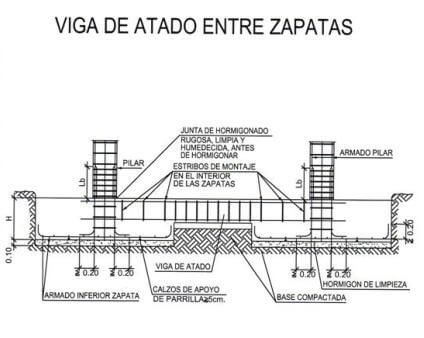
When it is advisable to tie them.
As we explained in a previous post, pad footings are a type of shallow foundation: blocks of reinforced concrete, either isolated or continuous, that bear the weight of the building’s structure. To reinforce them, they are sometimes “tied”, that is, connected by tie beams, strengthening and linking all the footings to withstand lateral thrust and avoid the dreaded differential settlement.
This is usually done in buildings with the following characteristics:
-On soils with low bearing capacity.
-On heterogeneous ground, where the soil characteristics vary greatly depending on depth and area.
-In areas with significant seismic activity.
-In high-rise buildings.
-In properties with several basements or below-ground floors.
The aim of a tied pad footing is to achieve continuity at the base of the foundations, making the footings work as a single whole, and thus trying to prevent one part of the ground from giving way and becoming uneven in relation to the others, causing significant damage to the structure that could compromise the mechanical strength and stability of the building. DPcon Reclamación Daños Constructivos.
Any questions?