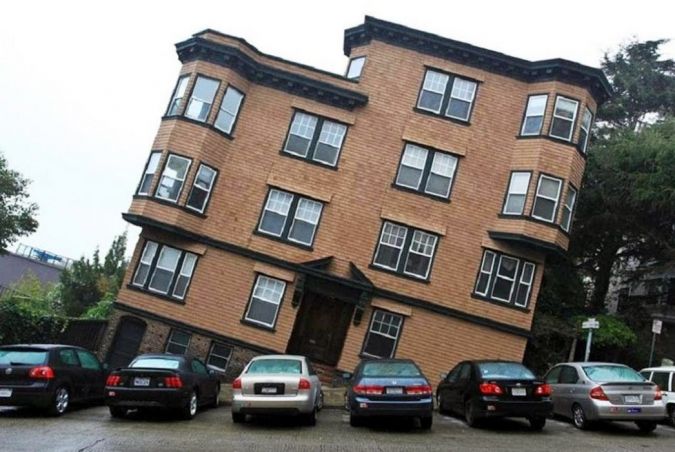
Differential settlement occurs when one or more footings or piles sink, unbalancing the foundation of a dwelling. The building tilts towards that point, and floor slabs and structural elements split and crack. It is often the most dangerous pathology in a house, as it threatens its collapse.
Claiming for structural damage caused by differential settlement
If your property has differential settlement, the best course of action is to contact us so that an expert architect (who usually also acts as a court expert) can properly assess the property and these structural pathologies.
This expert in construction damage will study the structural problems of your home to establish their origin and extent. To do so, they will visit the building, photograph all the cracks and fissures, and study the background, for which you should provide the project, the geotechnical study and any other documentation you have.
Since differential settlement may or may not have stabilised, the best approach is to monitor its evolution with crack gauges and check afterwards for any movement. Finally, the expert will draw up, with measurements, the most appropriate repair proposal for the property, and will cost it.
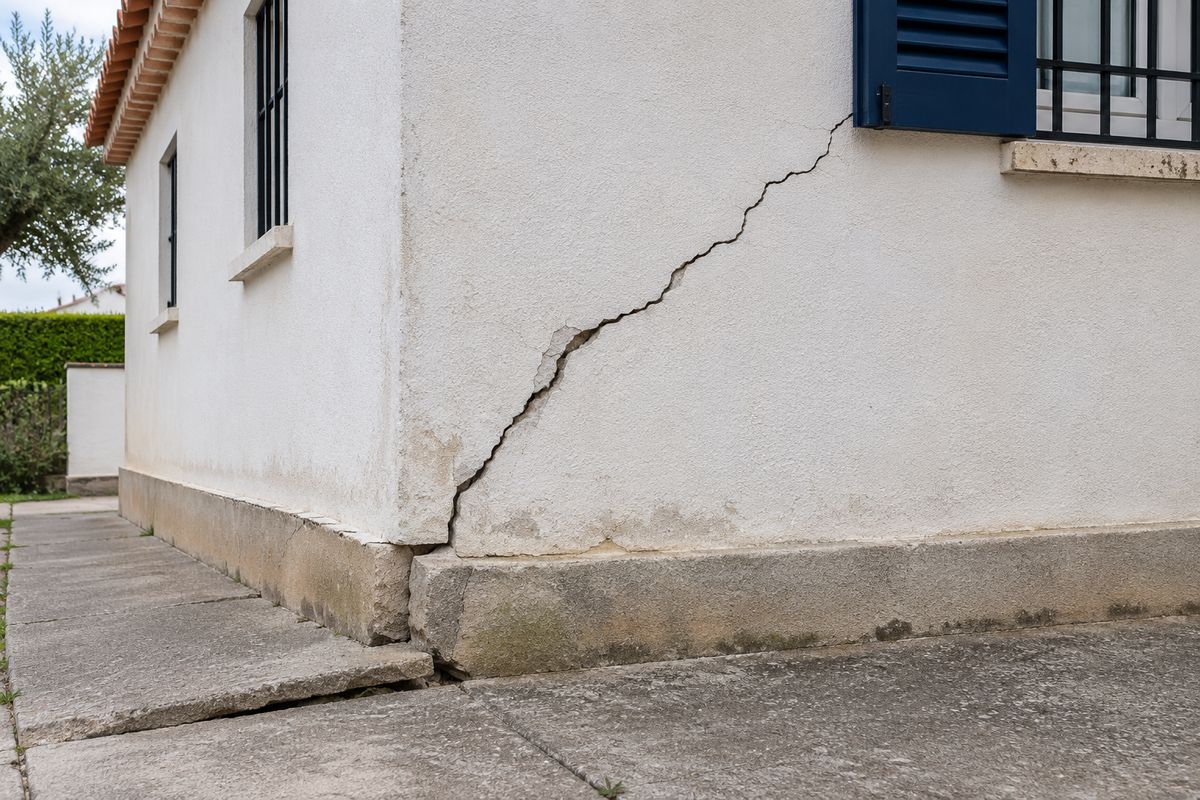
Differential settlement is simply an asymmetric movement in the foundation of the house. It causes a pronounced sinking of one structural element, which pulls on the remaining rigid elements so that the structure splits at its weakest point, usually perpendicular to the direction of the pull.
To use a simple comparison: if the foundation were a heavy table with four thin legs, settlement would be one of those legs sinking and breaking. This sinking would drag on the rest of the structure, which could not withstand the force and would break, forming an oblique crack perpendicular to the direction in which the leg sank.
Once the origin and extent of the differential settlement have been determined, together with a repair proposal, our legal department, made up of lawyers specialising in construction damage, will claim against those responsible for the construction.
How to claim for settlement cracks
There is a 10-year guarantee period for claiming for differential settlement. It starts to run from the moment the certificate of completion is issued (when the property is handed over). The time limit for bringing the action starts from the moment you are certain of the damage, and from then on you have 2 years (under article 18 of the LOE). Once the expert report is complete, that certainty will exist and those responsible can be sued.
Responsibility for differential settlement usually lies with the design architect and the site architect, as the problem will almost certainly lie in the foundation.
However, the developer (unless it is a self-development) is always ultimately liable as developer-seller, and claims can also be brought against them.
The causes of differential settlement may be related to project defects such as poor calculations, ground subsidence or foundation problems. The consequences are structural damage such as cracks.
Diagonal and staggered cracks caused by differential settlement
If you have diagonal and/or staggered cracks in your house, be careful: they are probably caused by differential settlement of the foundation. This characteristic crack shape usually occurs because the cracks run perpendicular to the direction of the pull. The stress normally comes from the corner perpendicular to the crack, and eventually the element breaks and cracks appear.
Sometimes it is claimed, as an excuse, that this is “normal settlement” of the building. Normal settlement movements generally occur within the first 2 years of the building’s life, when it comes under load and may move slightly until it reaches its final position.
They usually appear as small hairline cracks that never pose any structural threat. But when, several years after delivery, a dwelling shows widespread cracking with the characteristics of coarse cracks (more than 1 mm), oblique or zigzag lines, or even through cracks, this can by no means be considered normal settlement.
Diagonal or staggered cracks (marking the brickwork) are therefore often a strong indication of differential settlement. Please contact us.
If you have any questions, please contact us.