An expert architect will carry out the acoustic tests to check whether the building complies with the regulations. The expert report will include a repair proposal and a repair budget, which is what will be claimed in court from the architect, the quantity surveyor, the builder and/or the developer.
Poor sound insulation in a dwelling or homeowners’ association
Poor sound insulation affects the habitability of a dwelling and can cause serious inconvenience to homeowners. Noise can come from adjoining dwellings, from the floors above or below, from the boiler room, from the pressure booster system, from a communal garage door, from downpipes, from the lift, from outside noise, and so on.
The origin of this defect lies in deficient acoustic insulation of the internal partition walls, the external façades and the communal plant rooms.
There is not only noise that affects the health of the owners, but also vibrations, which are transmitted through the walls and are very annoying.
We have sometimes come across blatant non-compliance with the project. Take, for example, a homeowners’ association whose construction project specifies solid brick (“Mahón” type, for example) for the partition walls between dwellings, and the owners then discover, after an expert report, that the partitions were in fact built in plasterboard. Such breaches of contract are clearly actionable.
Claims for poor sound insulation in dwellings
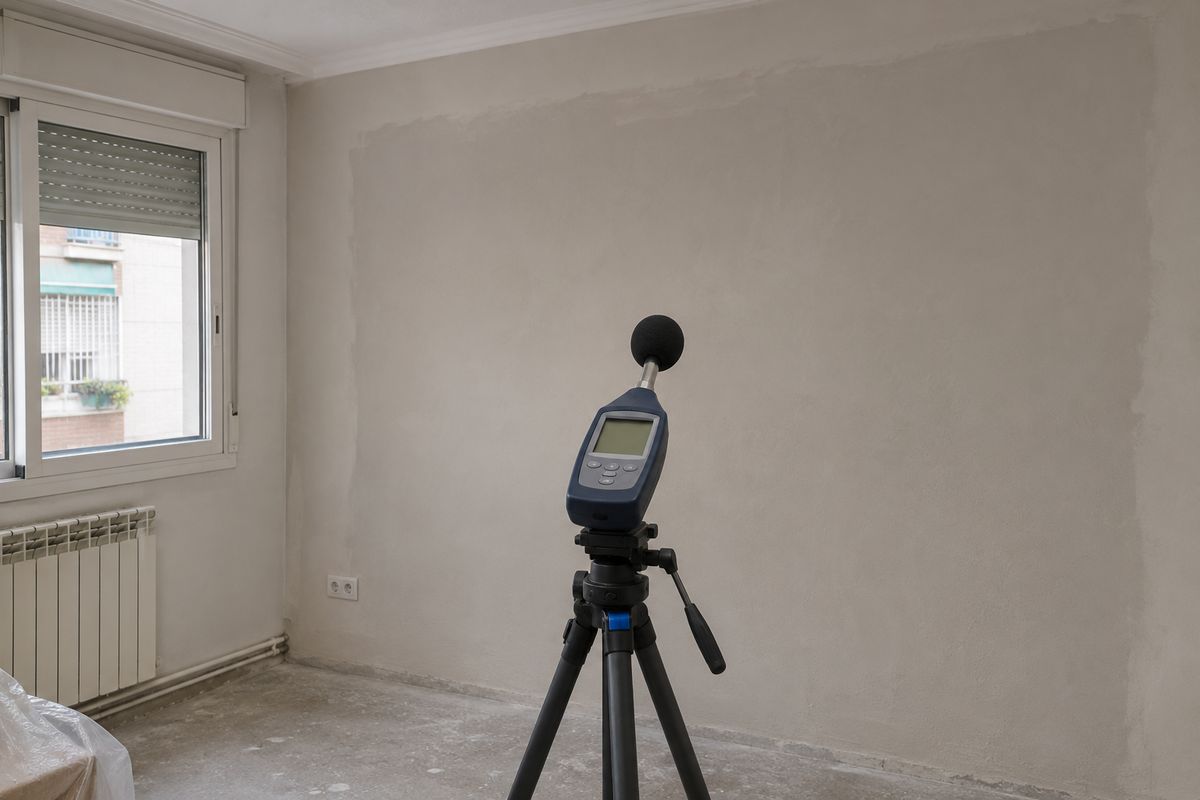
A claim for poor sound insulation must be accompanied by an expert report that includes the results of tests carried out with approved instruments: an acoustic sound level meter, sound diffusers, pink noise emission, ambient sound measurements, a dodecahedron loudspeaker, an amplifier, and so on. Another test is a check on the wall separating the dwellings, measuring the thickness of the vertical element: if it is less than 15 cm, it will not insulate the dwelling properly.
With a solid expert report, our lawyers will draw up well-founded claims to demand proper insulation and the repair of the home or building.
Poor acoustic insulation is not the only habitability damage that can be found in homes. There may also be poor thermal insulation, air leaks, bad odours from pipes, or damp. DPCON is committed to resolving all of these to improve the quality of life in your home.
Time limits for claiming habitability damage caused by poor sound insulation
The time limits for claiming deficient sound insulation are short. It is classed as a habitability defect, under the LOE, and is guaranteed for 3 years from the date of completion.
Another route is to claim against the developer for breach of contract. The time limits are different in this case: 5 years from the date the deed of sale was signed, if the property was purchased on or after 7 October 2015.
If the property was purchased before 7 October 2015, the limitation period runs, in any event, until 7 October 2020 at the latest.
Liability for poor sound insulation in dwellings
Responsibility for these defects, and the claim, must be directed against the architect, the quantity surveyor and/or the construction company, as determined by the expert report. The developer has subsidiary liability and can therefore also be held liable.
We must not forget that noise is an unpleasant, inarticulate and annoying sound. It produces undesirable effects for the person who suffers it and is detrimental to health and physical well-being. It is a pollutant: it is a mixture of different frequencies, it produces an annoying or uncomfortable sensation, whoever produces it, and it harms people. Noise interferes with the person, causing negative physiological or psychological effects.
If you have any questions, please contact us.