Contents: what to do about differential settlement
My house creaks and has cracks.
We do not want to be alarmist but, having analysed a great many homes with defects over many years and studied their history, when the owner of a detached house tells us they can hear their home “creaking” and that it has significant cracks, they should be concerned.
What can happen?
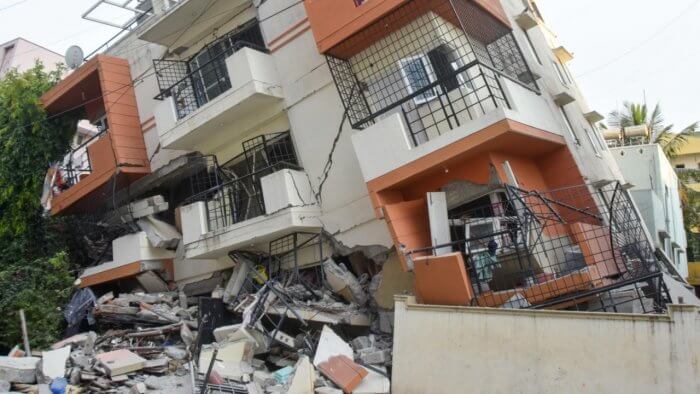
Differential settlement that shows itself in this way, with noticeable movement (almost overnight), loud creaking and cracks appearing, is very nearly a prelude to the worst thing that can happen to your house, both because of the danger and because of the cost of repair.
The worst that can happen is that the property collapses and comes down. This does not happen very often, but it is a real possibility that we have seen occur on occasion in our professional careers.
Indeed, of all the defects a building can have, the worst is the appearance of cracks (not tiny hairline cracks) caused by “differential settlement”.
How does differential settlement occur?
Let us start at the beginning. A house must have foundations proportionate to the weight they will bear and suited to the characteristics of the ground and the building.
The foundations, whether footings, piles, load-bearing walls or a reinforced raft, must be designed and guaranteed to bear the weight of the building while keeping it stable and level.
Naturally, for the foundations not to tilt or become unbalanced, they must in turn rest on uniform, strong, hard ground or firm rock; otherwise one of the points where the foundations provide their resistance may fail. It is as if one of the four legs of a chair has no support because the floor is uneven: the chair becomes unbalanced standing on three legs, and whoever is sitting on it may fall or the chair may break, because neither the chair nor the house is designed to bear the weight on only three legs.
This consequence is known in building pathology as differential settlement, and it is serious structural damage.
And what happens then?
Because the weight of the house is no longer borne evenly by the foundations and the ground, cracks appear, usually in a stepped, zigzag pattern.
The width of the cracks tells us how severe the settlement is (the wider they are, the greater the settlement), while their zigzag or diagonal path shows how significant it is, and the perpendicular to the line of the crack tells us where the thrust is coming from, that is, where the settlement is occurring.
The solution to differential settlement.
The solution involves injecting resins under the part of the foundations that has been left unsupported, or using another method to “underpin” that part of the foundations; or even, depending on the architect’s assessment of the house plans, and certainly after carrying out a geotechnical survey, installing piles that reach firm ground and connecting them to the foundation footings, or injecting resins into the ground. That way, if the work is done by experienced professionals, the problem is likely to be solved.
We therefore strongly recommend that, if this is your case, you get in touch with professionals.
DPcon Reclamación Daños Constructivos.
Any questions?