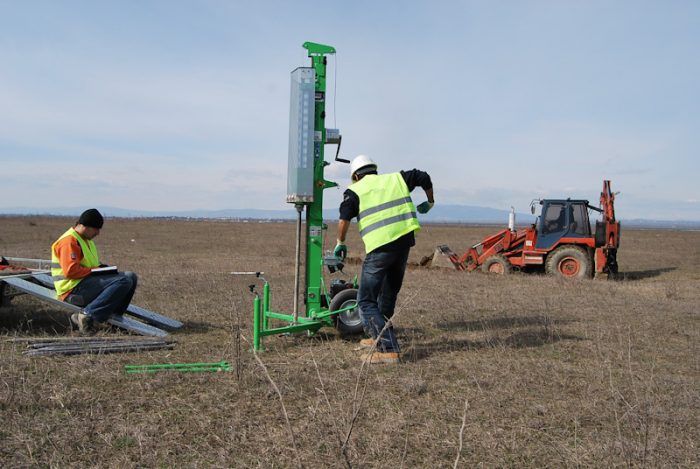
What is a geotechnical survey?
To construct a building, it is essential to understand the ground it is built on. This requires a geotechnical survey of the site. It involves drilling, boreholes and trial pits to obtain a sample of the ground layers and establish their nature, uniformity, compaction, hardness, etc., since project decisions and the foundations of the building will depend on that highly valuable information.
Based on the data from the ground analysis, which is normally carried out by specialist firms, one type of foundation or another will be recommended, since for some ground, depending on its hardness or compaction, it will be advisable to use braced pad footings, a reinforced slab or micropiles.
Is a geotechnical survey compulsory for a home?
Yes, since the Technical Building Code (CTE) came into force. For all residential buildings, public buildings and industrial buildings, a geotechnical survey must be carried out before construction.
However, it has always been the case, even before the CTE came into force and before the year 2000, that the designer was responsible for the site on which they had built. So if there was no geotechnical survey and the designer relied on other data, they bore the risk of getting it wrong, because the designer is responsible for knowing the ground on which they build and for adapting the foundations to its technical characteristics.
What happens if there is no geotechnical survey?
A building without a geotechnical survey is a serious risk, and if defects appear, such as differential settlement, they are very likely to be due to a lack of knowledge of the ground and the wrong choice of structure and foundations for the property.
If you have a problem with your building and believe that no geotechnical survey was carried out, contact us. An expert report can establish this so that a claim can be brought against those responsible. DPcon Reclamación daños constructivos.
Any questions?