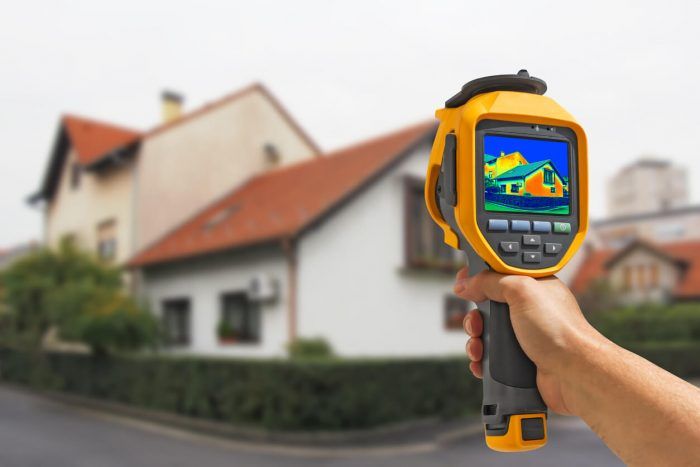
How they work and what they can detect.
Many construction problems are difficult to detect on the surface until damage appears, for example thermal bridges in buildings, which we discussed in previous posts: areas lacking adequate insulation or thermal envelope where there is a break in the uniformity of the construction, so that a significant temperature difference arises, which reduces energy efficiency and causes troublesome condensation.
But how can this internal temperature difference be detected without carrying out a disruptive opening-up test or exposing the inside of a partition wall? With thermography.
Thermal imaging cameras detect the infrared radiation emitted by all objects, which follow one rule: the more infrared radiation, the more heat they give off. Thermal imaging cameras translate the infrared radiation captured from the electromagnetic spectrum into colours, with a colour code indicating whether a surface is colder or warmer.
They are a very useful tool for finding the origin of building pathologies in a completely non-invasive way.
It is important to use high-resolution thermal imaging cameras that provide reliable data, and for the expert taking the images to know how to interpret that information.
As well as thermal bridges, thermal imaging cameras can detect:
-Heat loss due to air leaks through a window.
-Elements in electrical installations that are overheating or have some kind of problem.
-Problems or leaks in domestic hot water (DHW) installations.
-Overheating caused by problems in pump motors.
-Which photovoltaic panels are working.
-Etc., etc.
To gather the most complete information for its reports, DPcon has certified thermal imaging cameras and its experts are used to operating them. Contact us.
Any questions?