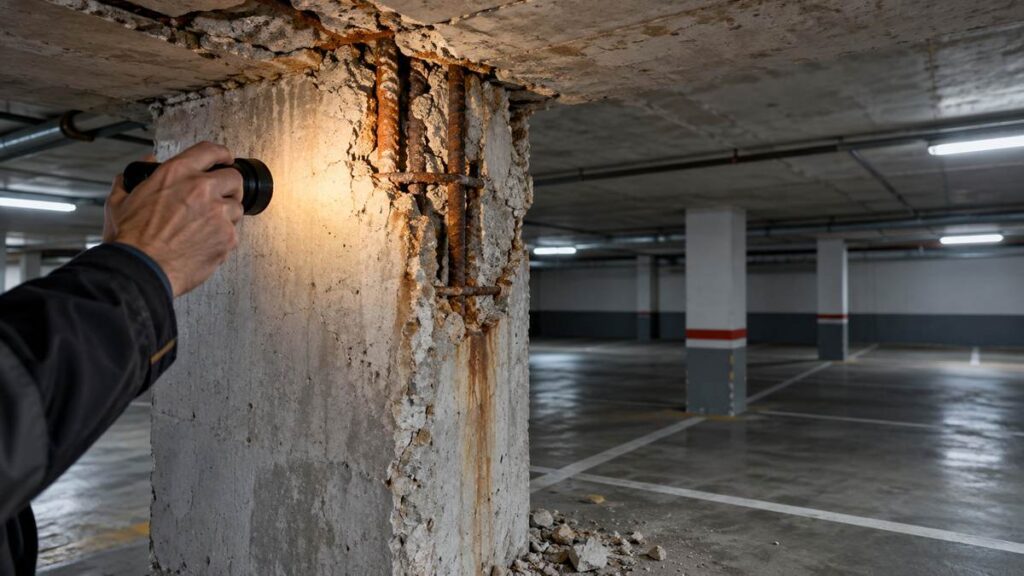
A crack that widens every winter, a door that suddenly no longer closes, a floor slab that sags or a garage with spalling concrete and exposed reinforcement. Behind many of these symptoms lie structural damage and building pathologies: defects that originate in the design, in the execution of the works or in the materials and that, if not tackled in time, compromise the safety of the building and the value of your home.
The good news is that, if you bought your home from a developer, the law protects you. Law 38/1999, the Spanish Building Act (Ley de Ordenación de la Edificación, LOE), imposes liability lasting 10 years for structural damage, 3 years for damage affecting habitability and 1 year for defects in finishes.
At DPcon we know these situations inside out, which is why we have put together this article to help people who are experiencing this kind of structural damage first-hand, so that they know how to identify it, who to claim against, the time limits that apply and other relevant aspects that we will clarify drawing on our extensive experience in court claims for construction defects.
What are building pathologies?
In construction, pathology is the study of the defects in a building: what causes them, how they develop and how they are repaired. By extension, we speak of “pathologies” to refer to the defects themselves: damp, cracks, hairline cracks, detached material, corrosion, deformation or condensation. As in medicine, the same visible defect (for example, a crack) can have very different causes, which is why a technical diagnosis is essential before carrying out repairs or making a claim.
Technical experts usually classify defects into three families:
- Physical defects: damp (rising damp, water ingress or condensation), erosion and soiling. They depend on water, temperature and atmospheric agents.
- Mechanical defects: cracks, hairline cracks, deformation (deflection), detached material and mechanical erosion. These are the ones most directly related to the structure.
- Chemical defects: reinforcement corrosion, carbonation of the concrete, aluminosis (high-alumina cement deterioration), efflorescence or attack by organisms such as fungi and wood-boring insects.
Not all pathologies are equally serious, nor do they all have the same time limit for claiming. What determines your rights is which part of the building is affected and which requirement is not met, and this is where the LOE classification comes into play.
What counts as structural damage in a home?
Article 17.1.a) of the LOE defines structural damage as “material damage caused to the building by defects or flaws that originate in or affect the foundations, supports, beams, floor slabs, load-bearing walls or other structural elements, and that directly compromise the mechanical strength and stability of the building”.
Put simply, damage is structural when the problem lies in the “skeleton” of the building and puts at risk its ability to remain standing safely. Some typical examples:
- Differential settlement of the foundations causing diagonal cracks in walls and partition walls.
- Columns or beams with hairline cracks, spalling or exposed rusty reinforcement.
- Floor slabs with excessive deflection (they “sag”) that crack the partitions and the flooring.
- Cracked or out-of-plumb load-bearing walls.
- Retaining or basement walls subject to earth pressures not allowed for in the design.
Note: a crack in a partition wall is not necessarily structural damage, but it can be a symptom of it. If you want to look into this further, you can do so in this other article on the difference between cracks and hairline cracks, written by our legal department at DPcon.
Structural damage, habitability damage and damage to finishes: differences and time limits
The LOE distinguishes three types of damage and assigns each one a different guarantee period. Knowing which one your case falls into is the first step to avoid losing the right to claim.
| Type of damage | What it includes | Examples | LOE guarantee | Who is liable |
|---|---|---|---|---|
| Structural (article 17.1.a) | Defects in the foundations, columns, beams, floor slabs or load-bearing walls that compromise stability | Foundation settlement, floor slabs that deflect, reinforcement corrosion, active cracks in load-bearing walls | 10 years | Developer, building contractor and technical professionals (designer, works director and site manager) |
| Habitability (article 17.1.b) | Failure to meet requirements on health and hygiene, energy saving, protection against noise, etc. | Damp and water ingress, condensation, lack of sound or thermal insulation, unusable garages | 3 years | Developer, building contractor and the technical professionals responsible |
| Finishes (article 17.1, final paragraph) | Imperfections in completion or finishing work | Superficial hairline cracks, paintwork, tiling, poorly fitted joinery | 1 year | Building contractor (and the developer, towards the buyer) |
These periods run from the date of handover of the works (the certificate signed between developer and building contractor), not from when you received the keys. That is why it is always advisable to ask for a copy of the handover certificate or the certificate of completion. And remember: these are guarantee periods, meaning that the damage must become apparent within them. We explain this in detail in LOE time limits are guarantee periods.
Identifying the warning signs of possible structural damage
You do not need to be a technical expert to spot that something is wrong. These are the signs that, in our experience carrying out expert assessments, most often conceal a structural problem:
| Symptom | Possible cause | Alert level |
|---|---|---|
| Diagonal cracks at around 45°, especially next to doors and windows | Differential settlement of the foundations | High: requires an expert assessment |
| Stepped cracks in brick façades | Movement of the foundations or the ground | High |
| Horizontal cracks beneath the floor slab or where partition walls meet the ceiling | Excessive deflection of the floor slab | Medium-high |
| Doors and windows that go out of square or stop closing | Deformation of the structure | Medium-high |
| Spalling on columns or garage ceilings with exposed rusty steel bars | Reinforcement corrosion due to insufficient concrete cover or damp | High |
| Floors that tilt or sink; skirting boards that come away | Settlement or failure of the ground slab | Medium-high |
| Cracks that grow over time (widen or lengthen) | Active defect; the damage has not stabilised | Very high: act now |
| Fine, superficial hairline cracks in the plaster or paint | Shrinkage or expansion of the render | Low: usually a defect in finishes |
If you think a crack is dangerous, do not cover it up, paint over it or plaster over it, as that does not fix it and, moreover, erases the evidence, which can then no longer be included in the expert report.
Examples of situations in which you can claim for structural damage and building pathologies
To show you how this works in practice, here are the situations that most frequently reach our firm and that lead to successful claims against developers and building contractors.
☑️ New-build home with cracks in the first few years
This is one of the most common cases. Two or three years after delivery, cracks start to appear in the partition walls and the façade, and the developer replies that “it is normal for the building to settle”. It is not always so. If the cracks follow a pattern (diagonal, stepped, concentrated in one area of the building) and grow over time, the most likely cause is differential settlement. As long as you are within the 10-year guarantee, you can claim.
☑️ Foundations miscalculated or designed without an adequate geotechnical survey
Undetected expansive clays, made ground or groundwater levels cause ground movements that the foundations cannot absorb. The Technical Building Code (CTE) requires a geotechnical survey, and its absence or inadequacy is a very strong argument against the designer. We explain this in Is a geotechnical survey compulsory?
☑️ Floor slabs that deflect and crack the partitions
When a floor slab deforms more than is permissible, the partition walls resting on it crack horizontally or diagonally, and ceramic floor tiles lift or develop hairline cracks. The cause usually lies in inadequate structural calculations, striking the formwork too early or unforeseen loads. Even if the crack appears in a partition wall, the cause is structural and the 10-year guarantee applies.
☑️ Garages and basements with reinforcement corrosion
Communal garages accumulate damp and salts. If the concrete cover is less than the regulations require, or the waterproofing of the basement walls fails, the reinforcement rusts, expands and causes the concrete to spall. This is a progressive pathology: the sooner you claim, the cheaper the repair.
☑️ Rising damp and water ingress
Damp is rarely structural, but it is a classic case of habitability damage (3-year guarantee): stains on the lower part of walls, salt deposits, mould, water ingress through the roof or terraces. As well as the home itself, damp can affect the structural elements if the water reaches the reinforcement.
☑️ Façades with detached material and cracks in the brickwork
Cladding that comes loose, bricks that develop hairline cracks at the corners or poorly detailed slab edges pose a risk to passers-by. Depending on their origin, they may be structural damage or habitability damage, and they usually affect the whole homeowners’ association.
☑️ Damage to the communal areas of the homeowners’ association
Roofs, structure, foundations, façades and garages are communal areas. In these cases the claim is usually led by the homeowners’ association following a resolution of the owners’ meeting, although each owner retains the right to claim for the damage to their own home. A good example is the case in which a well-known developer was ordered to pay over one million euros.
☑️ Second-hand home with damage the seller concealed
If you bought from a private individual and structural damage appears that was not visible, you may have two routes: an action for latent defects against the seller (with a very short time limit of six months from delivery, article 1490 of the Civil Code) and, if the building is still within 10 years of the handover of the works, an LOE claim against the developer, building contractor and technical professionals, which also protects subsequent owners.
Who can you claim against for structural damage?
The LOE identifies the so-called parties involved in the construction and divides liability among them. As a buyer, the following may be liable to you:
- The developer: is jointly and severally liable to purchasers together with the other parties involved, even if the defect was caused by someone else (article 17.3 of the LOE). It is therefore the first party your claim should be addressed to.
- The building contractor: for defects in execution, for those of its staff and subcontractors, and for the materials it supplied.
- The designer (architect or engineer): for errors in the calculations or design of the project.
- The works director and the site manager (technical architect): for failing to detect or correct defects during construction.
- The insurer providing the 10-year structural insurance (seguro decenal): homes must have material damage insurance covering structural damage for 10 years, under which the claim can be brought directly against the insurer. More information in our article on 10-year structural insurance.
When it is not possible to determine who caused the damage, or several parties contributed to it, liability is joint and several. That is why, in practice, the lawsuit is usually brought against several parties at once.
Time limits for claiming
This is where most claims are lost. Two different time limits must be distinguished:
| Time limit | What it means | Duration | From when |
|---|---|---|---|
| LOE guarantee | Period within which the damage must appear | 10 / 3 / 1 years | Handover of the works |
| LOE limitation period (article 18) | Time limit for bringing the action once the damage appears | 2 years | From when the damage occurs |
| Contractual liability | Action against whoever sold you the home (the developer) for breach of contract | 5 years (article 1964 of the Civil Code) | From when performance can be demanded |
| Latent defects (sale) | Action against the seller for hidden defects | 6 months (article 1490 of the Civil Code) | From delivery |
An example: if the works were handed over in 2018 and the structural cracks appear in 2025, you are within the 10-year guarantee, but from 2025 you have 2 years to claim. The limitation period can be interrupted by an out-of-court claim with proof of delivery, which is why it is so important to send a formal demand as soon as possible. Contractual liability against the developer can also be pursued alongside the LOE route and, on occasion, allows you to claim for damage that the LOE does not cover.
Where the building licence was applied for before the LOE came into force (May 2000), article 1591 of the Civil Code applies, with a different regime. A specialist lawyer will tell you which rules govern your case.
How to claim for structural damage, step by step
This is the process we follow at DPcon and that we recommend so that every claim has the strongest possible safeguards:
Step 1. Document the damage from day one
Take dated photographs, measure the width and length of the cracks (a ruler or a crack monitor will do) and repeat the measurements every few weeks to check whether they are developing. Also keep your communications with the developer, the property administrator or your neighbours. Do not repair or cover up anything before an expert has seen it.
Step 2. Gather the documentation for the home
- Purchase deed and private purchase contract.
- Handover certificate for the works or certificate of completion (to calculate the time limits).
- Building logbook (Libro del Edificio) and specifications.
- 10-year structural insurance policy (the developer is obliged to hand it over with the building logbook).
- Previous claims, incident reports and the replies received.
Step 3. Commission an independent expert report
This is the key element. An expert (architect, technical architect or engineer) inspects the building, draws up a defect map, monitors the cracks, carries out the necessary opening-up tests and other testing (rebound hammer, core sampling, carbonation depth, supplementary geotechnical survey…) and concludes what has happened, why, who is liable, how it is repaired and how much it costs. Without a solid report, the developer will simply deny the facts.
Step 4. Send a formal demand to the developer
With the report in hand, a formal demand with proof of delivery is sent to the developer and, where applicable, to the building contractor and the 10-year structural insurer, by burofax (formal registered letter) with certified content or by notarial letter. It describes the damage, attaches the report and demands repair or compensation within a reasonable period.
This letter interrupts the limitation period and, since Organic Law 1/2025, it also serves as proof that the pre-litigation negotiation step (MASC), now required before filing a civil lawsuit, has been attempted.
Step 5. Notify the claim under the 10-year structural insurance
If the damage is structural and the home is less than 10 years old, open a claim directly with the insurer. The insurer will often send its own expert: do not sign any statement of agreement or accept partial repairs without the backing of your own report. The courts frequently order the 10-year structural insurer to pay for structural damage when the expert report proves the damage.
Step 6. Negotiation and out-of-court settlement
Many claims are resolved at this stage: the developer acknowledges the problem and undertakes to carry out repairs or pay compensation. If a repair is agreed, it is advisable to set out in writing the scope of the works, the time frame and supervision by a technical expert you trust. It is possible to obtain compensation for construction defects without a trial.
Step 7. Filing a lawsuit
If there is no response or the offer is insufficient, the lawsuit is filed before the Court of First Instance against the liable parties and the insurer. At trial, the expert report and the expert’s testimony are decisive. The judgment may order the repair of the damage or payment of its cost, plus other proven losses.
Mistakes that can cost you your claim
- Repairing or painting over the cracks before an expert has seen them.
- Letting more than 2 years pass from when the damage appears without interrupting the limitation period.
- Claiming only by telephone or email without proof of receipt.
- Accepting the “cosmetic repair” proposed by the developer without tackling the cause.
- Relying solely on the expert sent by the insurer or by the building contractor itself.
What can you obtain with a claim?
Depending on the case, you can obtain:
- Repair of the damage (repair in kind, “in natura”), carried out by the developer or the building contractor under technical supervision.
- Financial compensation equivalent to the cost of the repair, so that the affected party can commission it from a company they trust.
- Associated expenses: temporary rehousing while the works last, furniture storage, technical reports, etc.
- Other proven losses, such as the loss of value of the home or, in some cases, non-pecuniary (moral) damage.
In very serious cases, where the home becomes uninhabitable or the defect is fundamental, it is even possible to seek termination of the sale and repayment of the price.
Frequently asked questions about structural damage and building pathologies
As a summary of everything explained and discussed in this article, we conclude with a condensed overview in the form of the most common questions we are asked at the firm about structural damage and building pathologies:
☑️ What is considered structural damage in a building?
According to article 17 of the LOE, it is damage caused by defects that affect the foundations, columns, beams, floor slabs, load-bearing walls or other structural elements and that directly compromise the mechanical strength and stability of the building.
☑️ What is the difference between a building pathology and structural damage?
A pathology is any defect or flaw in the building (damp, hairline cracks, condensation, corrosion…). Structural damage is the most serious pathology, the one that affects the building’s skeleton. All structural pathologies are pathologies, but not all pathologies are structural.
☑️ How long do I have to claim against the developer for structural damage?
The damage must appear within 10 years of the handover of the works and, from when it appears, you have 2 years to claim (article 18 of the LOE). That time limit can be interrupted by a formal demand with proof of delivery. There is also the contractual action against the developer, with a time limit of 5 years.
☑️ Who should I claim against: the building contractor or the developer?
It is always in the buyer’s interest to claim against the developer, because it is jointly and severally liable with the other parties involved even if it did not cause the defect. The claim is normally also brought against the building contractor, the technical professionals and the 10-year structural insurer.
☑️ How do I know whether a crack is structural?
Suspicious cracks include those running diagonally at 45°, stepped cracks, horizontal cracks beneath floor slabs, cracks that go right through the wall and cracks that grow over time. Only an expert can confirm this after inspecting and monitoring the crack.
☑️ Does 10-year structural insurance cover structural damage?
Yes. Homes must have 10-year material damage insurance covering structural damage. You can claim directly against the insurer, as well as against the parties involved in the construction.
☑️ Do I need an expert report to claim?
In practice, yes. It is the evidence that proves the existence of the damage, its cause, the liable parties and the cost of the repair. Without it, the claim has very little chance of succeeding.
☑️ Can I claim if I bought a second-hand home?
Yes. The LOE guarantees also protect subsequent owners as long as the periods counted from the handover of the works have not expired. You may also have an action for latent defects against the seller, although its time limit is only six months.
☑️ Who claims if the damage is in communal areas?
The homeowners’ association, following a resolution of the owners’ meeting, claims for the damage to the communal areas. Each owner can also claim for the damage to their own home.
☑️ Is it dangerous to live in a building with structural damage?
It depends on how serious the damage is and whether it is active. Many defects allow you to keep living in the home while they are investigated and repaired, but if there are rapidly growing cracks, visible deformation or detached material, you must notify a technical expert immediately and, where appropriate, the local council.
Conclusions
We have therefore seen that a building pathology is any defect or flaw that appears in a building, whereas structural damage is the most serious pathology: the one that affects the foundations, columns, beams, floor slabs or load-bearing walls.
You should also bear in mind that the developer is always liable to the buyer, together with the building contractor and the technical professionals who caused the damage (article 17 of the LOE), and that the guarantee periods are 10 years (structure), 3 years (habitability) and 1 year (finishes), counted from the handover of the works. Once the damage appears, you have 2 years to bring a claim in court (article 18 of the LOE).
The key element of any claim is an independent expert report proving the cause, the liable parties and the cost of the repair. At DPcon we have the experience and the right professionals (lawyers and expert architects) to handle a claim for structural damage and building pathologies from start to finish. If you are in a similar situation, contact our team and we will analyse your case to define the right strategy to follow.
Any questions?