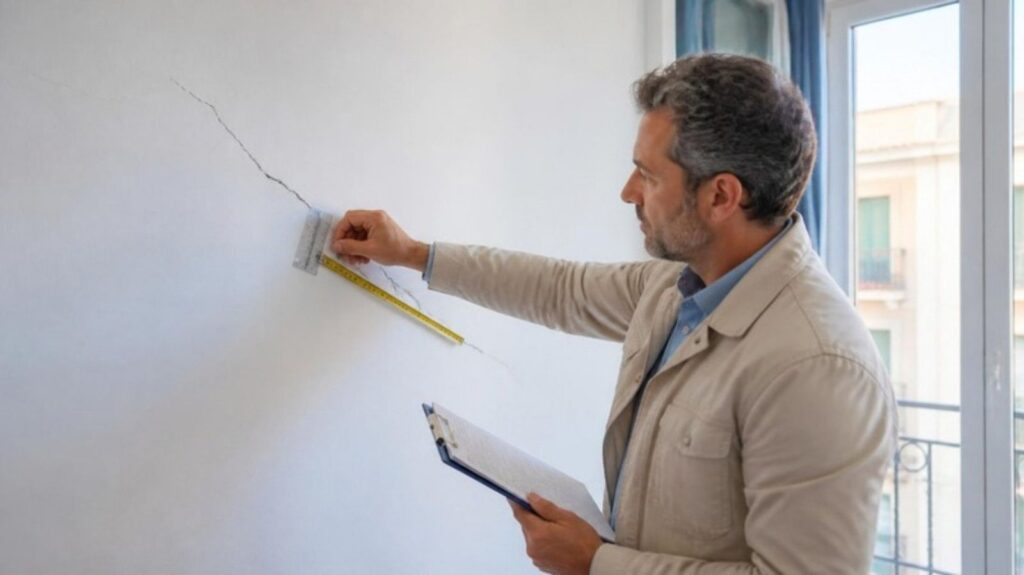
A crack in the living-room wall, a diagonal hairline crack next to a door that no longer closes properly, or a façade that is starting to open up. Sound familiar? In many homes they are part of the building and, naturally, the first reaction is usually concern, wondering whether it is really dangerous; the second is wondering whether it is possible to claim for cracks in a home.
The short answer to that last question is yes, you can claim for cracks in your home, provided that the crack or cracks have a cause attributable to a third party (a construction defect, neighbouring works, a seller who concealed the problem, a homeowners’ association that fails to maintain the communal areas…) and that the claim is made within the time limit.
There are further conditions and factors to consider, which our team of specialists at DPcon explains in detail below, so that you know every route available for making a claim, with particular emphasis on how much time each one gives us, the step-by-step process and several real examples of situations in which it is worth taking legal action.
Can all cracks be claimed for?
Not all marks on a wall are the same, nor do they all have the same legal prospects. To know whether a crack can be claimed for, four questions need to be answered: what caused it, how serious it is, who is liable and how much time has passed.
It is very important to bear in mind that hairline cracks and cracks are not the same thing. Technically, we speak of a hairline crack when the opening is small (generally under 1 mm) and affects only the render or plaster, and of a crack when it is wider and may go right through the building element. We explain this in detail in another article we wrote on the difference between cracks and hairline cracks.
Having said that, a hairline crack can also be claimed for, especially in a new build, and a hairline crack that grows may be the first symptom of a structural problem.
Warning signs that should be checked as soon as possible
Be very careful if you notice any of the following at home:
- Cracks running diagonally (at 45º) from the corners of doors and windows.
- Stepped or zigzag cracks following the brick joints.
- Cracks that grow in size over the weeks or that reappear after being filled.
- Doors and windows that catch or will not close, uneven floors or tiles that lift.
- Horizontal cracks in load-bearing walls or where they meet the floor slab.
- Cracks in the façade accompanied by falling material or by damp inside.
If you recognise any of these symptoms, it is worth finding out when wall cracks are dangerous and consulting a technical expert without delay.
Most common causes of cracks in a home
From our extensive experience at DPcon in construction defects and construction law, most claims for cracks in a home arise in the following contexts:
- Differential settlement and foundation problems, often due to an inadequate geotechnical survey. In this article you will find more information on differential settlement.
- Excessive deflection of floor slabs and beams, which cracks the partitions resting on them.
- Missing or poorly executed expansion joints.
- Shrinkage of mortar, plaster or concrete due to poor workmanship or curing.
- Works on adjoining buildings: excavation, demolition, vibration or underpinning.
- Water or drainage leaks that wash away the ground beneath the foundations.
- Renovations that remove or weaken load-bearing walls without a technical design.
Options for claiming for cracks in a home
The appropriate legal route depends on each situation. Choosing correctly is decisive, however, because each one has its own liable parties and different time limits. These are the main options:
New or refurbished home: guarantees under the Spanish Building Act
Law 38/1999, the Spanish Building Act (Ley de Ordenación de la Edificación, LOE) protects owners against material damage caused by construction defects. Its article 17 establishes three guarantee periods, which run from the handover of the works:
- 10 years for damage affecting the structure (foundations, columns, beams, floor slabs, load-bearing walls) that compromises the strength and stability of the building.
- 3 years for damage affecting habitability (for example, cracks in the façade that cause water ingress or insulation problems).
- 1 year for defects in finishes, for which the building contractor is liable.
Once the damage appears within those periods, you have 2 years to bring a claim in court (article 18 of the LOE). We can bring the claim against the developer, which is jointly and severally liable in all cases, and also against the building contractor, the architect, the site manager (technical architect) or the laboratory, depending on the origin of the defect. In addition, the LOE protects both the first buyer and subsequent purchasers of the home. You can find more information in the following article on liable parties and time limits for structural damage.
Contractual liability: when what was delivered is not what was agreed
Regardless of the LOE, if the home delivered does not comply with what was contracted, you can claim against whoever sold it or whoever you hired to build or renovate it for breach of contract (articles 1101 and 1124 of the Civil Code). The general time limit is 5 years (article 1964 of the Civil Code).
This route is very useful when the LOE guarantees have already expired or the defect does not fall within them.
Second-hand home: latent defects
If we buy a second-hand home and the cracks already existed but were not visible (or the seller disguised them), we can claim against the seller for latent defects (article 1484 of the Civil Code) and ask for a price reduction or the cancellation of the sale. The big drawback is the time limit: only 6 months from delivery (article 1490).
You should know that if the seller deliberately concealed the defect, there may be other actions for fraud (dolo) with longer time limits. And if the building is less than 10 years old, we could also claim under the LOE against the parties involved in the construction. We explain this in detail in is it worth taking action over latent defects?.
Cracks caused by a neighbour’s works or by the adjoining building
This is one of the most frequent cases: the building next door is demolished, a basement is excavated or the neighbour carries out a renovation, and cracks appear in your home. Here the claim is based on non-contractual (tortious) liability (article 1902 of the Civil Code) against whoever caused the damage: the developer of the works, the building contractor, the owner and their liability insurers. The time limit is 1 year from when the damage becomes known (article 1968.2 of the Civil Code), although for damage that continues to develop the courts usually count it from when it stabilises. Even so, it is best not to wait.
Cracks in communal areas: the homeowners’ association
Foundations, structure, façade and roof are communal areas. If the cracks are in them, the homeowners’ association is obliged to maintain them (article 10 of the Horizontal Property Act, LPH) and must answer for the damage those elements cause to our home. If the origin is a construction defect, the association can claim against the developer and the parties involved in the construction, for which it needs a resolution of the owners’ meeting authorising the president. See here what majority is needed to claim for construction defects.
Insurance: 10-year structural, home and homeowners’ association policies
10-year structural insurance (seguro decenal) is compulsory for residential developments (article 19 of the LOE) and covers structural damage for 10 years. We can claim for cracks in a home directly from the insurer, even if the developer has disappeared or is in insolvency proceedings.
As for home insurance, most policies exclude construction defects and progressive settlement, although they may cover sudden damage or third-party liability. We recommend reading the policy carefully.
Finally, the homeowners’ association’s insurance may come into play when the damage originates in communal areas.
We go into this in more depth in does insurance cover damage to my home?.
If you rent your home
If the tenant does not claim against the building contractor, they must notify the cracks to the landlord, who is obliged to carry out the repairs needed to keep the home habitable (article 21 of the Urban Leases Act, LAU). It will then be the owner who, in turn, claims against the liable parties.
Summary table: routes for claiming for cracks and time limits
| Route | When it applies | Who to claim against | Time limit |
|---|---|---|---|
| LOE, structural damage | Cracks that compromise the structure (foundations, columns, floor slabs, load-bearing walls) | Developer, building contractor, technical professionals and 10-year structural insurer | 10-year guarantee + 2 years to sue |
| LOE, habitability | Cracks affecting the watertightness, insulation or use of the home | Developer, building contractor and technical professionals | 3-year guarantee + 2 years to sue |
| LOE, finishes | Hairline cracks in the finishes of plaster, render and partitions | Building contractor (and developer) | 1-year guarantee + 2 years to sue |
| Contractual | What was delivered does not match what was agreed (sale, construction or renovation) | Seller, developer or contractor | 5 years |
| Latent defects | Second-hand home with hidden defects that pre-date the sale | Seller | 6 months from delivery |
| Non-contractual (tortious) | Neighbouring works or damage caused by third parties | Developer, building contractor and owner of the works, and their insurers | 1 year |
| Horizontal property | Cracks in the façade, structure or other communal areas | Homeowners’ association | Act as soon as possible; depends on the action |
| Tenancy | Tenant of a home with cracks | Landlord | Notify the owner immediately |
How to claim for cracks in a home, step by step
We will now set out the process in detail should we finally decide to claim for cracks in our home. If you have any questions about any step, leave us a comment and we will answer them:
☑️ Step 1. Document the cracks from day one
Take dated photographs and videos, place a ruler or a coin alongside for scale and note when each crack appeared. If we want to know whether a crack is active, a technical expert can fit plaster tell-tales or crack monitors to measure how it develops. Do not fill or paint over the cracks before an expert has seen them (we would be destroying the evidence).
☑️ Step 2. Gather the documentation for the home
Purchase deed, contract with the developer or contractor, handover certificate or key handover record, first occupancy licence, building logbook (Libro del Edificio), 10-year structural insurance policy, previous emails or claims and repair quotes.
☑️ Step 3. Commission an expert report
This is the key piece. An architect or technical architect must determine the cause of the cracks, their seriousness (structural, habitability or finishes), the liable parties and the cost of the repair. Without a good expert report, the other side will deny liability and the judge will have no basis for a ruling against them.
At DPcon we specialise in expert reports for construction defects.
☑️ Step 4. Identify the legal route and keep track of the time limits
With the report in hand, a specialist lawyer will decide which action to bring (LOE, contractual, latent defects, non-contractual) and against whom. Review our article on the time limits for claiming for damage to your home: the LOE guarantee periods cannot be interrupted, whereas limitation periods can be interrupted by a claim with proof of delivery.
☑️ Step 5. Send an out-of-court claim by burofax
Send a burofax (formal registered letter) with certified content and acknowledgement of receipt to all potentially liable parties (developer, building contractor, technical professionals, owner of the neighbouring works…) and to their insurers. It should describe the damage according to the expert report, attach a copy, put a figure on the repair and allow a reasonable period to respond. Also notify your own insurer and, if communal areas are affected, the homeowners’ association.
☑️ Step 6. Try to reach an agreement: the MASC requirement
Since 3 April 2025, Organic Law 1/2025 requires, as a general rule, an attempt at an appropriate dispute resolution method (MASC) before filing a civil lawsuit: direct negotiation, mediation, conciliation, a confidential binding offer, etc. If the other party does not respond within 30 days, the requirement is deemed to have been met.
A well-drafted formal demand can serve this purpose, and the request interrupts the limitation period. If a repair agreement is reached, put it in writing. Bear in mind that a repair agreement does not release the other party from liability if the repair does not solve the problem.
☑️ Step 7. File the lawsuit
If there is no agreement, a lawsuit is filed before the Court of First Instance, normally with a lawyer and a court representative (procurador). The claim seeks the repair of the damage in accordance with the expert report or, in the alternative, payment of its cost, plus any additional losses (accommodation during the works, damaged furniture, etc.). At trial, the expert confirms and defends their report. If the claim succeeds, the other party is commonly ordered to pay the legal costs.
We explain this in more detail in how to take action against a developer for construction defects.
☑️ Step 8. Enforce the judgment
If the losing party does not voluntarily repair or pay, enforcement of the judgment is requested so that the court compels them to comply, even by commissioning the repair from a third party at their expense.
Examples of common situations in which it is worth claiming for cracks
These are the situations that most often lead our clients at DPcon to take legal action over cracks in their home:
New home with hairline cracks in the partitions after two years
A couple move into a brand-new flat and, two years later, hairline cracks appear in several partitions and where they meet the ceiling. The developer claims that “it is normal for the building to settle”. The expert report determines that they are due to excessive deformation of the floor slab. As the damage affects the structure, it falls within the LOE’s 10-year guarantee, and the claim is brought against the developer, the building contractor and the site management team.
Detached house with diagonal cracks and doors that will not close
A seven-year-old detached house begins to show 45º cracks in the façade and partitions, and the doors catch. The cause is differential settlement of the foundations due to an inadequate geotechnical survey. This is structural damage: the claim is brought within the 10-year guarantee against the parties involved in the construction and directly against the 10-year structural insurer.
Second-hand flat with cracks covered up with paint
On moving a piece of furniture, the buyer discovers a crack that had been filled and painted over just before the sale. They have 6 months from delivery to claim against the seller for latent defects, and if it can be proved that the crack was knowingly concealed, further actions are considered. If the building were less than 10 years old, they could also rely on the LOE.
Building work on the plot next door
After the basement of an adjoining building is excavated, cracks appear in the walls and ceilings of several homes. The claim is brought on the basis of non-contractual (tortious) liability against the developer, the building contractor and their insurers, with a time limit of 1 year.
Practical advice from DPcon: if you know that works are about to start next door, ask for a pre-works condition survey of your home to be drawn up.
Cracks in the façade causing water ingress
Cracks in the façade of an eight-year-old building let water into several homes. As the façade is a communal area, the homeowners’ association resolves at an owners’ meeting to claim against the developer and the building contractor, and each owner can also claim for the damage inside their own home.
We recommend the following article of ours on construction defect problems in homeowners’ associations.
Poorly executed renovation (your own or a neighbour’s)
After a renovation in which a partition wall that was in fact a load-bearing wall was removed, cracks appear in the home and in the flat above. The owner can claim against the contractor for breach of contract (5 years), and the affected neighbours can claim against the owner who carried out the works through the non-contractual route.
Mistakes that can cost you your claim
Among others, we would highlight the following:
- Repairing or covering up the cracks before an expert has examined them. Without evidence, there is no claim.
- Letting the time limits pass, especially the 6 months for latent defects and the one year for damage caused by neighbouring works.
- Claiming against only one of the liable parties, when liability may be shared or is unclear.
- Submitting a generic report that does not identify the cause, the liable parties or the cost of the repair.
- Accepting a “cosmetic” repair without a written agreement or a subsequent technical inspection.
- Suing without first trying to reach an agreement (the MASC requirement), which may lead to the lawsuit not being admitted.
What can you obtain and how much does it cost to claim?
The aim of the claim is for the home to be restored to the condition it should have been in. In practice, we can obtain the repair of the cracks and their cause (for example, underpinning of the foundations) or compensation equivalent to its cost, together with other proven losses: alternative accommodation during the works, damage to furniture or loss of value of the property.
The main costs are the expert report, which varies depending on the complexity of the case, and the fees of the lawyer and the court representative (procurador). If the claim is upheld, an order to pay legal costs can offset a large part of these expenses. That is why it is important to carry out an initial assessment of the case before starting the process.
Frequently asked questions about claiming for cracks in a home
We summarise the content above by answering, in question-and-answer format, the most common questions we are asked about claiming for cracks in a home:
☑️ How long do I have to claim for cracks in my home?
It depends on the route. In a new build, the LOE provides guarantees of 10 years (structural damage), 3 years (habitability) and 1 year (finishes) from handover, plus 2 years to sue from when the damage appears. For breach of contract you have 5 years; for latent defects in a sale, 6 months from delivery; and for damage caused by neighbouring works, 1 year.
☑️ Does home insurance cover cracks in the wall?
Normally not, because most policies exclude construction defects and progressive ground settlement. It may, however, cover sudden damage or third-party liability. In new homes, structural damage is claimed from the 10-year structural insurance, which is compulsory.
☑️ Who pays for cracks caused by a neighbour’s works?
Whoever caused the damage: the developer of the works, the building contractor or the owner, and their liability insurers. The claim is brought through the non-contractual route under article 1902 of the Civil Code, with a time limit of 1 year, supported by an expert report proving the link between the works and the cracks.
☑️ What do I do if I bought a second-hand house and it has cracks?
If the cracks existed before the sale and were not visible, you can claim against the seller for latent defects within 6 months of delivery. If the building is less than 10 years old, you can also claim against the developer and the building contractor under the LOE.
☑️ Is it normal for a new home to have hairline cracks?
Small shrinkage hairline cracks may appear in the finishes, but a new home should not have cracks. Even hairline cracks in finishes can be claimed for during the first year, and if they grow or recur they may point to a bigger problem that should be assessed by an expert.
☑️ Do I need an expert report to claim for cracks?
In practice, yes. The expert report establishes the cause of the cracks, their seriousness, the liable parties and the cost of the repair. It is the main evidence both in negotiations and at trial.
☑️ Can I claim if the developer has disappeared or is in insolvency proceedings?
Yes. For structural damage you can claim directly from the 10-year structural insurer, and also against the building contractor and the technical professionals involved in the works, who are liable according to their part in the defect.
☑️ What do I do if the crack is in the façade or in communal areas?
Notify the president of the homeowners’ association or the property administrator. The homeowners’ association must repair the communal areas and, if the cause lies in the construction, it can claim against the liable parties following a resolution of the owners’ meeting. You can also claim for the damage caused to your own home.
☑️ Is it compulsory to try to reach an agreement before suing?
Yes. Since 3 April 2025, under Organic Law 1/2025, before filing a civil lawsuit you must attempt an appropriate dispute resolution method, such as direct negotiation or mediation. If the other party does not respond within 30 days, the requirement is deemed to have been met.
☑️ How long does a claim for cracks take?
If an out-of-court agreement is reached, it can be resolved in weeks or a few months. Court proceedings usually last between one and three years, depending on the court and on whether the judgment is appealed.
Conclusions
Cracks in a home can be claimed for when someone is liable for them and action is taken in time. The key lies in correctly identifying their origin with an expert report, choosing the appropriate legal route (LOE, contractual, latent defects, non-contractual or homeowners’ association) and not letting the time limits pass, which in some cases are very short.
Always important: if we detect cracks in the home, do not cover them up; instead, document them and promptly seek a professional assessment to support the future claim.
At DPcon we bring together in a single team technical experts and lawyers specialising in construction defects, which allows us to study the cracks, determine their cause and the liable parties and, most importantly, handle the claim from start to finish, both in negotiations and in court. We work throughout Spain.
If you are in a similar situation and want to claim for cracks in your home, get in touch with our team and we will be delighted to meet you and advise you. More information about our service for claiming for cracks in walls.
Any questions?