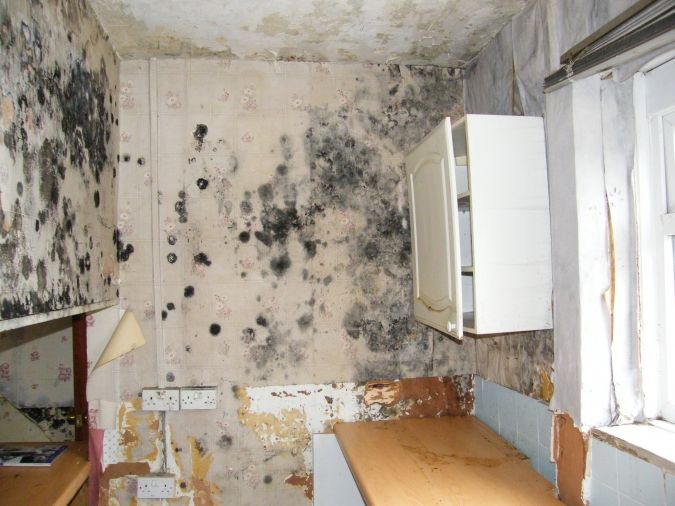
Thermal bridges are the result of incorrect and inadequate insulation of external walls.
This lets water in and causes condensation (tiny droplets of water that later turn black inside the home, on both walls and floors).
Imagine a corner column that faces directly onto the outside of the building: its conductivity of cold and heat is high. Touch the column in the sun in summer and you will notice it is very hot; in winter it is cold all over. If the column also faces directly into the home and we do not clad it so that it does not pass on the cold from outside, for example by enclosing it in brick, it will also be very cold inside the home. But the home is warm from heaters, radiators and so on. So what happens? When the warm air touches the column it condenses against it, forming tiny drops of water. It is the same phenomenon as when you take a hot shower: steam appears and, on contact with the mirror, quickly condenses into tiny drops of water that we have to wipe away with our hand to see ourselves.
Well, to prevent this from happening in rooms facing the façade, the columns must be insulated, or rather, the conduction of cold through those columns or enclosure walls must be broken; in short, the thermal bridge linking the cold outside, which “chills” the column, with the warmer inside must be broken.
Failing to do so is a flagrant building defect, unequivocally attributable to the architect and perfectly identifiable, and it is classed as a “design defect”. These are not mere aesthetic defects. They are well established and defined.
It is unacceptable to argue, as a justification for such defects, that the injured party should ventilate their home as often as necessary to bring down the humidity level.
The existence of thermal bridges causes condensation in homes, owing to excess relative humidity or cold outside.
So it is not a question of needing to ventilate the house three or nine times a day. This building defect is attributable to the designer, for failing to provide any kind of insulation at these points in the project; not only because waterproofing was not included in the initial project, but also because of incorrect execution.
Architects are held responsible for damp appearing at the edges of floor slabs, with the courts stating that they must bear the cost of repair, consisting of “removing the existing render to gain access to the slab edges and insulating them to prevent thermal bridges”.
Condensation damp, consisting of stains, mould and speckling on external enclosure walls and in wardrobes against the façade, is due to the existence of thermal bridges and therefore implies a design defect for which the architect alone is liable.
The courts generally take the view that incorrect and inadequate insulation of external walls causes defects known as thermal bridges, which let water in and cause damp, probably through condensation inside the home, on both walls and floors.
The duty of the architect is to give the appropriate instructions for the correct execution of the works, and this must lead them to issue the technical directions needed to prevent thermal bridges at the floor slabs, in accordance with what the project provided for that purpose (thermal bridges being the cause of the damp on the walls and ceilings of the homes in the areas close to the façades).
It is not a matter of inadequate ventilation of the homes, whatever any party-appointed expert may say, but of the existence of a building defect known as thermal bridging.
You can tell us about your case so that we can study it and advise you, free of charge and with no obligation on your part.
Any questions?