Water ingress caused by a rising water table from a river or the sea: who is responsible, and how can the problem be solved?
Water in garages and basements
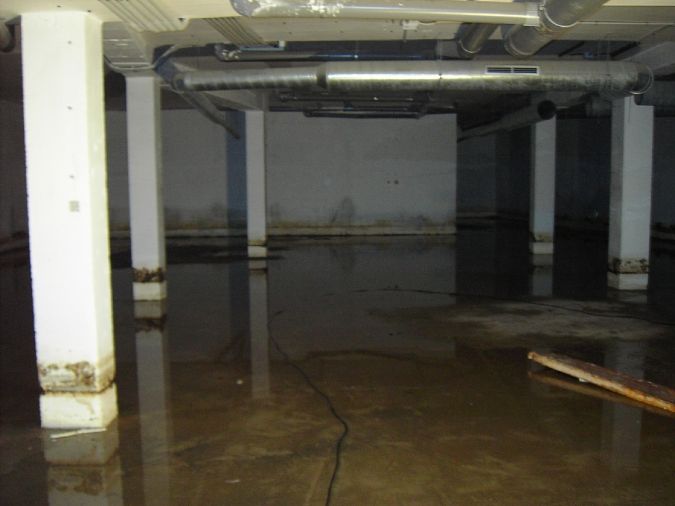
And there is plenty of it on this Iberian issue, as quite a few homeowners’ associations install sump pumps to mitigate (merely patch up) the effects of the water. This is due to a rising water table, either because the building is close to an old riverbed or dry watercourse, or because it is near the sea or under its influence. The servile defences of developers and architects tend to be monotonous: that the damp and water ingress are not significant; that even if they exist, there is no permanent rise in the water table “sustained” over time…; that watertightness measures were already provided for in the design…; and moreover, that the causes are (sometimes, or so they say) force majeure, namely exceptional rainfall in recent years; in other words, it rained. And they say it without batting an eyelid.
Sometimes there are judges who take the bait and fall for it, and acquit the architects. If we add that the developer is insolvent or in insolvency proceedings, things get worse and the car owner is left in the lurch. They will spend the rest of their life unable to park their car in the dry, getting their hats and suitcases wet every time they drive into their parking space. The foundation slab, which takes in the water, will gradually have its reinforcement affected by that water.
Fortunately for our clients, there was a solution, as the judgment was appealed and overturned. The Provincial Court gave an in-depth lesson on the obligations of architects, above all when there is a water table close by, and on the checks and work they must carry out.
The court explained why the architect was also responsible. Because, as well as being the designer, he also acted as works director. He is the one who directs the progress of the works in technical terms and, as such, is responsible for inspection and direction, above all of something as essential in a building as its foundations and structure; and it is not enough to record the irregularities he notices: he must check that they have been rectified or remedied before issuing the certificate of completion, the only way to ensure that the owners or subsequent purchasers are not caught out or cheated of their contractual rights.
So if the defect stems from insufficient waterproofing of the garage walls or the reinforced slab, this cannot go unnoticed by the architect, since he must know from the textbook that its absence will lead to drips, water ingress and damp. It makes no difference whether he is a novice, or whether it is due to passivity or tolerance, or to going along with changes made by the developer and/or building contractor.
It is obvious that when a building is suspected of having a nearby water table (when excavation begins, it is plain to see, and water is already visible), a geotechnical survey of the ground is undeniably necessary, and in our case the survey was conspicuous by its absence. And it is not enough to state in the design or on a form that it had to be done, and leave it at that; it has to be done. If it is not carried out and the defect appears (water in the garage, a water table attacking the structure or slab), it means the architect has been passive in carrying it out, and liability follows as a matter of course.
The building was within the river’s area of influence, specifically on a drainage watercourse. Consequently, there was a permanent water table. To prevent the effects that this water table might cause, specific measures to guarantee watertightness should have been provided for in the design, not merely a bituminous membrane. And no such measures were provided for in the original design or carried out during construction. The basement was therefore not designed to withstand a water table above the level of the ground-bearing slab.
Basements in those areas must include these provisions, because otherwise water will pour in. There may also be sulphates in the water, which require protection for the concrete. So, in addition to the usual measures, greater emphasis must be placed on other measures, choosing the right concrete with a water-resistant cement, as well as reinforcing the joints between the slab and columns, the slab and retaining walls, and lift pits, which are the weak points where water ingress occurs.
And by the way, sump pumps may mean that the owners’ hats and suitcases do not get wet, but the water will still be there, and it will go on corroding or undermining the reinforcement.
www.dpcon.es
Any questions?