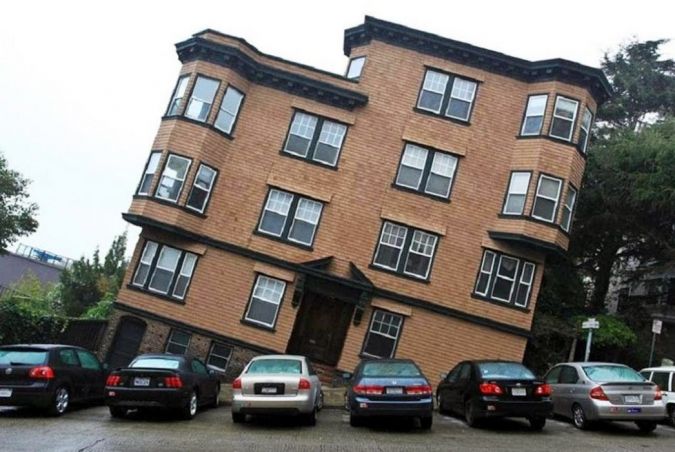
Sloping floors or walls that are out of plumb may be a sign of differential settlement
If you have noticed through simple everyday things that your home has a certain tilt (such as putting a marble on the floor and seeing it always roll in the same direction, turning on the shower and seeing the water run only to one side, doors that close by themselves and always to the same side…), you should get proper advice and consult a technical expert, because your building may be affected by a fairly serious and worrying defect, such as differential settlement in the foundations.
Depending on the type of foundations, the cracks resulting from differential settlement do not always have to take the form of a relieving arch (the typical diagonal crack), nor do they have to be excessively large and alarming. Not many of them may have appeared yet, and they may even run horizontally (if the foundations are a raft slab, for example). But a slope in the flooring of a home, the façade or the external walls (even if the cracks are not very significant) is a sign that the building is leaning, and if this movement has not stopped, it is very dangerous, because beyond a certain tilt there will be a significant risk of collapse, so urgent action is needed to stop the movement.
What specialist tests can be carried out to check the tilt?
In this case, a professional should confirm the tilt and check whether it is still active. The most commonly used tools are:
1) Laser level: this tool projects a cross-shaped laser beam onto the walls, marking the horizontal and the vertical. The projected beam makes it possible to confirm whether there are centimetres of difference from the vertical and horizontal lines marked by the beam.
2) Plumb line: an instrument consisting of a metal weight hanging from a string, used to mark the vertical line. It works by gravity and has three parts: the metal clip that is fixed to the wall, the string, and the weight, which is the part that hangs. If, once in place, the vertical marked by the plumb line moves away from the vertical wall surface, this means there is a tilt.
3) Spirit level. This gives the horizontal and the vertical through the position of the bubble within the marked limits. If the bubble goes beyond the marks, the wall or floor on which it is placed is not completely level. It should be a professional 60 cm level (a smaller one would only be useful for measuring whether a single tile is level, not the flooring as a whole).
Once the tilt has been confirmed, and if it is also found to be increasing, urgent action is needed to secure the stability of the home.
Any questions?