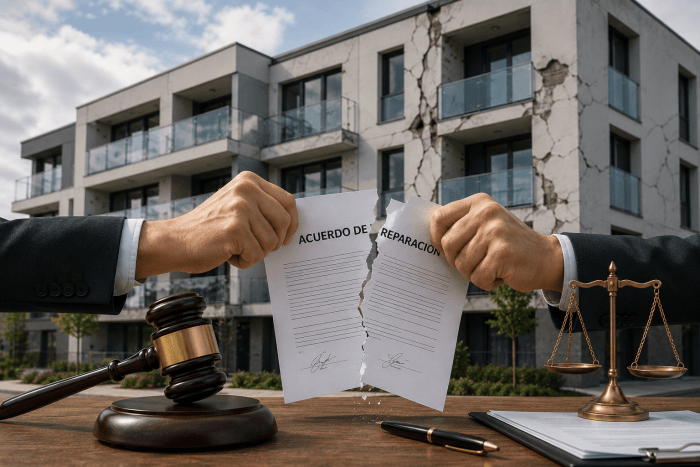
A repair agreement does not release the developer from liability.
Sometimes, after a new residential development is handed over with defects and the buyers make their first complaints and claims, the developer or the building contractor undertakes in writing to repair and remedy those defects. However, the existence of a repair agreement between the developer and the homeowners’ association does not automatically mean that the developer and seller of the homes is released from liability, especially when the damage has not been properly repaired and reappears.
We have recently obtained a new judgment, handed down on 27 April 2026 by the Civil Division of the Tribunal de Instancia de Madrid (Plaza N.º 61), which deals with this issue. The judgment substantially upholds the claim brought by a homeowners’ association in Móstoles against the developer of the building, ordering it to answer for numerous construction defects in the development, and addresses two legal questions of enormous practical relevance: the standing of the President of the homeowners’ association to claim for damage to private elements and the releasing effect of earlier settlement agreements with the building contractor.
1. Subject of the dispute: Widespread construction defects
The homeowners’ association filed a claim in ordinary proceedings, bringing an action for contractual liability (article 1101 in conjunction with article 1124 of the Civil Code) against the developer and seller of the building.
On the basis of a rigorous expert report, the homeowners’ association sought the remedying of serious deficiencies that made the property unfit for the purpose for which it had been bought. The damage identified included:
- Damp caused by water ingress in the garages and in areas adjoining the garden.
- Defects in the drainage system.
- Hairline cracks in the façade.
- Defects in railings, access walkways, terraces, metal joinery and ironwork.
- Damp, hairline cracks, odours and defects in the laminate flooring inside several homes.
The amount claimed, and ultimately awarded by the Court, comes to €224,588.61, together with an order for the defendant to pay the legal costs.
- The two main legal issues resolved by the Court
The developer tried to avoid liability by raising several procedural and substantive objections, all of which were dismantled one by one by the judge.
- A) The President’s standing to claim for damage inside the homes (private elements)
The developer argued that the President of the homeowners’ association lacked standing to sue for damage affecting the interior of the flats (private elements), claiming that each owner should have sued individually.
What does the Court say? Relying on well-established Supreme Court case law (such as the Supreme Court judgments of 16 March 2011, 11 April 2014 and 21 March 2019), the judgment points out that:
Case law presumes that the President is authorised to act on behalf of the homeowners’ association unless the contrary is proven.
The Court finds that, where damage to private elements stems from or is connected to deficiencies in communal areas (such as damp or cracks in the façade), the President has full standing to claim jointly for the repair of the entire wall, both outside and inside. Restricting this power would run counter to the community’s interest in litigating under a single legal representation.
- B) The “false” releasing effect of the earlier agreement with the building contractor
As mentioned, the other key argument in the developer’s defence was the existence of a settlement agreement signed in 2022 between the homeowners’ association and the building contractor, which formally closed the issues existing up to that date. The developer sought to rely on that document to claim that there were no further defects left to claim for.
What does the Court say? The court flatly rejects this argument for three fundamental legal reasons:
Different parties: The defendant developer was neither a party to nor a signatory of that agreement with the contractor. Agreements reached between parties who are not involved in the proceedings cannot be relied on against the claimant.
Latent defects: The defects claimed in this lawsuit are different and qualify as latent defects that were not covered by the earlier agreement.
No waiver of claims: The settlement document contained no express waiver of civil claims against the developer.
When a developer hands over a residential development with damage or construction defects and undertakes to repair them, this is normally interpreted as an attempt to perform, a remedy, or partial performance of its obligations. But it does not have full “releasing effects” if the end result does not eliminate the defect. Under civil law, an obligation is not considered properly performed when performance is defective, unsuitable, insufficient or merely apparent.
The developer could only argue for a complete release from liability if there were something akin to an express waiver of claims, a clearly concluded settlement, an unequivocal final discharge, or a definitive acceptance of the repairs. Even then, the courts tend to interpret these clauses restrictively where consumers are involved or there are latent defects, ongoing damage or serious construction defects. Particularly in the case of homeowners’ associations, judges usually require the waiver to be express, informed, specific and not generic. A mere signature of “approval” or a record of acceptance of repairs is not usually enough if the damage later reappears.
- Conclusion: A key victory for homeowners’ associations
In the end, Plaza nº 61 of the Tribunal de Instancia de Madrid upheld our claim in full, ordering the developer to compensate the homeowners’ association in full with more than €224,000, regardless of what had previously been signed with the building contractor.
This judgment makes it clear that property developers cannot hide behind the bureaucracy of homeowners’ associations or behind patch-up repairs or partial agreements with the parties involved in the construction to avoid their contractual liabilities.
It is important to know that, although the developer or the building contractor may initially be allowed to repair and remedy all poorly executed work, you should not sign anything expressly waiving any claim.
If you have any questions, contact us, DPcon Reclamación Daños Constructivos.
Any questions?