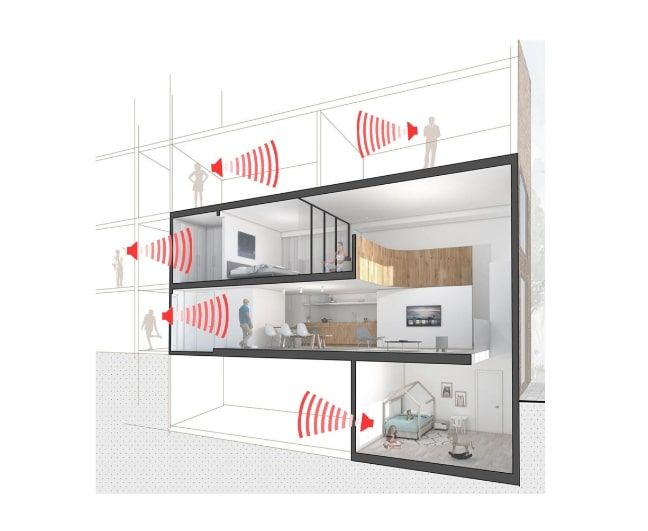
Sound insulation required in the different rooms
Habitability is a basic building requirement set out in article 3.1.c of the LOE, and a key element of habitability is protection against noise.
The objective of the basic requirement “Protection against noise”, according to article 14 of the DB HR, is to limit, within buildings and under normal conditions of use, the risk of nuisance or illness that noise may cause to users as a result of the characteristics of the building’s design, construction, use and maintenance.
To meet this objective, buildings shall be designed, built and maintained so that the building elements forming their rooms have suitable acoustic characteristics to reduce the transmission of airborne noise, impact noise, and noise and vibration from the building’s own installations, and to limit reverberant noise in the rooms.
The regulations therefore specify objective parameters and verification systems, compliance with which ensures that the basic requirements are satisfied and that the minimum quality levels of the basic requirement of protection against noise are exceeded.
All of this is contained in the Basic Document “DB HR Protection against Noise”, which sets out the verification procedures to check whether or not the requirements of the Technical Building Code are met as regards airborne sound insulation, impact sound pressure level, reverberation time, vibration from installations, etc. However, depending on the type of rooms and on whether they belong to the same unit of use, the DB on Protection against Noise establishes different acoustic requirements.
To know which technical insulation requirement must be met, it therefore matters a great deal what type of room we are talking about, whether it must be insulated from noise coming from another unit of use or from another type of room with other functions, and even whether they share doors or windows. Obviously, the insulation that homes must have from the building’s plant room, or from outside noise, is not the same as the insulation required between interior partitions within the same property.
It should be made clear that a unit of use is a part of a building intended for a specific use whose users are linked to one another; for example, a home, an office or, in a hospital, a room with its adjoining bathroom would each be a unit of use.
On the other hand, the types of room are usually:
- Habitable rooms, i.e. any room capable of being lived in (this does not include, for example, storage rooms or lofts).
- And Protected rooms: these are the rooms, among the habitable ones, that must have the highest acoustic requirement, such as bedrooms and living rooms in residential buildings, classrooms in educational buildings, operating theatres and wards in hospital buildings, and offices in administrative buildings, etc.
For example, as regards Airborne sound insulation, article 2.1.1 of the DB HR Protection against Noise states:
Interior separating building elements, as well as façades, roofs, party walls and floors in contact with the outside air forming each room of a building must have, together with the adjacent building elements, characteristics such that the following are met:
a) In protected rooms:
i) Protection against noise generated in rooms belonging to the same unit of use in private residential buildings:
– The A-weighted overall sound reduction index, RA, of the partitions shall not be less than 33 dBA.
ii) Protection against noise generated in rooms not belonging to the same unit of use:
– The airborne sound insulation, DnT,A, between a protected room and any other habitable or protected room in the building not belonging to the same unit of use, which is not a plant room or activity room, and which adjoins it vertically or horizontally, shall not be less than 50 dBA, provided that they do not share doors or windows.
Where they do share them, the A-weighted overall sound reduction index, RA, of these shall not be less than 30 dBA and the A-weighted overall sound reduction index, RA, of the enclosing wall shall not be less than 50 dBA.
iii) Protection against noise generated in plant rooms and activity rooms:
– The airborne sound insulation, DnT,A, between a protected room and a plant room or activity room adjoining it vertically or horizontally shall not be less than 55 dBA.
iv) Protection against noise from outside:
– The airborne sound insulation, D2m,nT,Atr, between a protected room and the outside shall not be less than the values given in table 2.1, according to the use of the building and the values of the day noise index, Ld, defined in Annex I of Royal Decree 1513/2005 of 16 December, for the area where the building is located.
And
b) In habitable rooms:
i) Protection against noise generated in rooms belonging to the same unit of use, in private residential buildings:
– The A-weighted overall sound reduction index, RA, of the partitions shall not be less than 33 dBA.
ii) Protection against noise generated in rooms not belonging to the same unit of use:
– The airborne sound insulation, DnT,A, between a habitable room and any other habitable or protected room in the building not belonging to the same unit of use, which is not a plant room or activity room, and which adjoins it vertically or horizontally, shall not be less than 45 dBA, provided that they do not share doors or windows.
Where they do share them and the buildings are residential (public or private) or hospital buildings, the A-weighted overall sound reduction index, RA, of these shall not be less than 20 dBA and the A-weighted overall sound reduction index, RA, of the enclosing wall shall not be less than 50 dBA.
iii) Protection against noise generated in plant rooms and activity rooms:
– The airborne sound insulation, DnT,A, between a habitable room and a plant room or activity room adjoining it vertically or horizontally, provided that they do not share doors, shall not be less than 45 dBA. Where they do share them, the A-weighted overall sound reduction index, RA, of these shall not be less than 30 dBA and the A-weighted overall sound reduction index, RA, of the enclosing wall shall not be less than 50 dBA.
c) In habitable rooms and protected rooms adjoining other buildings:
The airborne sound insulation (D2m,nT,Atr) of each of the enclosing walls of a party wall between two buildings shall not be less than 40 dBA or, alternatively, the airborne sound insulation (DnT,A) of the two enclosing walls together shall not be less than 50 dBA.
To check whether or not your home complies with the noise protection regulations, our technicians can carry out acoustic measurements with calibrated sound level meters, or even open inspection holes to check whether your property was properly insulated during construction. If non-compliance is confirmed, our legal department can take legal action against those responsible on your behalf.
DPcon S.L. Reclamación Daños Constructivos.
Any questions?