People ask us about it for construction defects, for claims against owners in arrears, for claiming for damage caused by faults attributable to the town council or to the public authorities; for everything. How do you interrupt the dreaded limitation period?
First of all, it should be made clear that interrupting the limitation period is a way of keeping the right to claim alive. So that a matter does not become time-barred (one where, for example, there is 1 year to claim), something has to be done to stop the clock so that the deadline does not pass. The law provides three ways of interrupting it: a) a court claim; b) an out-of-court claim; and c) any acknowledgement of the debt by the debtor.
The courts say that limitation is an institution that must be applied with caution. What does this mean? Watch out: as with the offside rule, when in doubt there is no limitation, that is, the period is deemed to have been correctly interrupted. For these reasons:
Interruption will always occur when the holder of the right unequivocally shows the other party their decision to obtain payment or repair, or whatever it may be, without the personal involvement of the interested parties being necessary (it may be the lawyer, the property administrator or the president), since the rules on representative mandate also apply in this area, with full effect even where the mandate is verbal.
If it is shown that the homeowners’ association’s property administrator, or its lawyer, has taken steps, acting on their client’s instructions and for the client’s benefit, with the representatives of the developer, housing cooperative, owners in arrears, architects, insurers, building contractors, etc., seeking an amicable solution and claiming the compensation sought, then the limitation period has been interrupted.
In other words, the limitation period will be interrupted when the holder of the right shows the other party their unequivocal intention to claim for the damage, regardless of the form used to claim it.
For an out-of-court claim to interrupt the limitation period, it does not need to be made in writing or to take any particular form; proving that it was made is another matter, but the difficulty of proof should not be confused with form, and case law has accordingly held that this type of claim can take various forms, such as letters claiming for damage or claims made by a lawyer under a verbal mandate “on behalf of my clients”.
Even conversations held in pursuit of an agreement between the parties, as well as «telephone contacts between the lawyers for both parties that took place subsequently» with the same aim, are conduct that the courts regard as interrupting the limitation period.
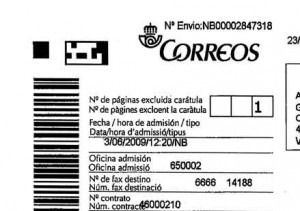
But there is nothing better than a letter or burofax (formal registered letter) with acknowledgement of receipt, as it provides reliable proof of the date and of receipt. Nor should it be overlooked, however, that in the absence of one, and following an important body of legal opinion, this is a problem of proof (of the existence of the claim and its date) and not a problem of form; that is, it is one thing for the form of the claim to be irrelevant to its interrupting effect, and another for the existence of such a claim as an interrupting act to have actually been proven.
Any questions?