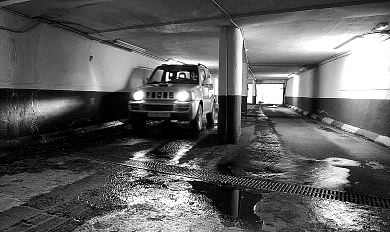
Below we set out some basic notions so that you can easily classify the different types of damp that can be found in garages. Learning a little about how to classify them will help us deal with them, because depending on the type, the solution will be more or less complicated or costly, and liability will also differ.
Damp coming from the perimeter walls, caused by lateral water ingress due to a lack of waterproofing of those walls. Any repair inside the garage is practically a waste of time, because to do it properly it has to be done from outside. The work should be carried out from outside, removing whatever elements allow access, and waterproofing the back face of the wall. Solutions based on building cavity walls with a false inner leaf are not usually satisfactory.
Damp coming from the ground itself, -from the bottom upwards- in which case it is essential to establish where the property is located: whether it is near the beach or a river, and whether the water table is high. In that case, the foundations –even if they are a reinforced slab- may be poorly waterproofed or sealed. If the damp is of this kind, it is easy to identify through a water analysis –simply a syringe and a small sterile container bought at a chemist’s (€2)- and you can take a sample yourself and send the water for analysis to a specialist laboratory (€50), and the analysis will tell you:
If the water comes from underground streams, it may be due to a design oversight, or to the lack of waterproof cement in the construction.
If it is chlorinated water, it may come from faults in the town council’s supply network entering the building’s foundations. A claim may be brought against the public authority or the water concession company.
Or if it is salty, it may be seawater, in which case the foundation basin has not been made watertight. The foundations should have been treated with waterproof cement (which does not let damp or water through)
It may also come from leaks or drips due to faults in the drainpipes, mainly at the bends of the foul water or rainwater pipes installed on the underside of the garage floor slab.
With these simple observations, and by taking some photographs and sending them to us before the owners’ meeting at which the matter is to be discussed, you will be able to tell the owners how serious the damp is and whether it can be claimed from those responsible.
Any questions?