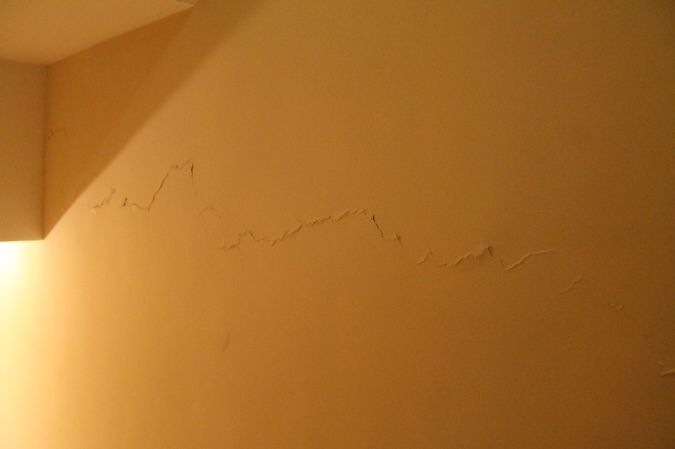
I own a terraced house and quite pronounced cracks appeared shortly after
(*) A real query which, given how frequent and important it is, we reproduce as a very common query/answer, omitting its origin and leaving out any details that might reveal the person’s identity.
“I own a terraced house with a semi-basement/garage, ground floor and upper floor, bought new in September 2010.
Shortly afterwards, quite pronounced cracks appeared on the upper floor, all of them diagonal; the windows and doors facing the street are going out of square and some do not even close.
A year after buying it, I contacted the building contractor so that the 10-year structural insurance (seguro decenal) would be notified of possible structural damage, since there are 15 terraced houses and the only one showing this damage is mine, which is at the end, on a corner. The insurer told me it is due to settlement of the house (?…) because it is a new build, which I resignedly accepted, and there the matter rested…
Over this time I have noticed that the house is constantly moving: in summer the cracks widen and the doors do not even close (because they are out of square), whereas in winter the doors close perfectly.
About a year ago, I brought an architect I know to see my house, and he told me that everything seemed to point to expansive clays, owing to poor foundations… and he advised me to put the matter in the hands of a lawyer, as he believed they would have to repair the whole house, not just the foundations.
Well, that is exactly what I did a year ago: I contacted a ‘trusted’ lawyer, and to this day I still know nothing about the matter. He says he has sent a burofax to the insurer and is waiting for them to reply… etc. Frankly, I feel completely lost, and since this is my house (with its mortgage) it is not something to put to one side. I would like to know how you work, your fees, etc…”
OUR ANSWER TO THE CLIENT
The matter you have, or rather the problem you are suffering, is serious.
A differential settlement showing up as diagonal cracks such as those you describe, and above all if an architect you know has already warned you that the foundations were built on expansive clays, is a rather delicate matter. Not only is there no guarantee that the building has stabilised, but a large inflow of rainwater or a burst pipe, etc. could make the problem very much worse.
In our view, the response must be immediate, and that is what we tell our clients. Although in principle we are talking about a 10-year guarantee for structural damage, once the defects are known, and if you acknowledge that you know about them (in writing, by fax, by email), the law requires you to sue within two years.
So even though you may think you still have years of guarantee left and believe it expires in 2020, the period is shorter, or may even have already run out. It depends on whether you have already acknowledged the damage.
Letting the period lapse through oversight, negligence or ignorance is fatal and irreversible. It means that although you have a serious matter that is, in principle, “solvable” and relatively easy to win (provided action is taken promptly and the professionals involved know what they are doing), if this does not happen you may lose that one opportunity.
As regards your query, the first thing you should know, and find out, is whether or not your lawyer has filed a lawsuit in court.
Yes or no; which lawsuit, on what date, its content and the court.
You must know clearly and unequivocally what the lawyer has done on your behalf, above all whether he has sent burofaxes, filed an application for conciliation, or sent any document to an insurance company, the architect, the developer, etc. You must receive and keep a copy of all this documentation, if there is any.
Secondly, have you had an expert report drawn up on the defects in your home? If so, send us a copy by email. Although we assume, from the wording of your query, that you have not.
Did you go to a notary to grant a power of attorney for litigation in favour of court representatives (procuradores) and that ‘trusted’ lawyer? Did you give your lawyer documentation such as a copy of your deed, a copy of the Building Log Book, the certificate of completion, a copy of the 10-year structural insurance policy, etc.?
When you speak of the “insurance”, which insurance do you mean: the architect’s, your home insurance, or the developer’s 10-year structural insurance? What is the name of the company?
All of these are details and documents needed to file a lawsuit in court; if you have not given them to your lawyer, it is highly unlikely, indeed impossible, that he has filed a proper lawsuit in court.
We can review that documentation and, where appropriate, after obtaining your lawyer’s consent to take over the case, our Legal Department could handle the entire proceedings.
If not (if you have nothing and nothing has been done), in order to study the viability of your claim, these are the documents and steps needed to start a court claim:
– Send us a copy of the certificate of completion (CFO).
– Have crack monitors been installed? Has your home been measured with plumb lines, or have the profiles of the vertical or horizontal surfaces been measured with a laser?
– The fact that your windows go “out of square” and do not close in summer, yet fit in winter, is due to expansion and contraction with heat and cold, but also to their lack of clearance given the tilt of the building.
– A copy of the expert report (if you have commissioned one from an architect).
– A copy of the Building Log Book.
– Photographs and a description of the cracks and other construction defects in your home. Especially any diagonal or stepped cracks or hairline cracks, as many as possible.
– The full address of your home.
We are sorry to be so blunt, but we need to know EVERYTHING THAT HAS OR HAS NOT BEEN DONE, as there is no time to lose.
Once we receive these documents, we would provide you with quotes from our architects for an expert report (if one has not been done) and a quote for the lawyer’s fees, together with an explanation of all the steps involved in this type of claim, but only once we clearly know the state of your case, what has been done and what has not yet been done (whether or not a lawsuit has been filed in court, etc.… etc.).
Yours sincerely, Dpcon SL
Any questions?