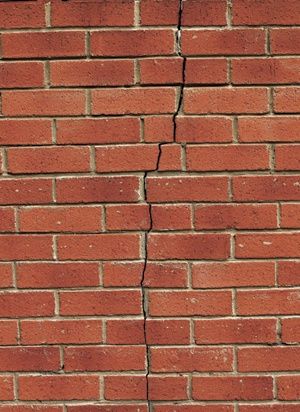
How to tell a crack at an expansion joint from one caused by differential settlement.
Sometimes homeowners or presidents of homeowners’ associations raise the alarm and ask us to check on site a very dangerous crack that has opened up in the wall or façade of the building. When we arrive, we see that it is an expansion joint in the wall.
An expansion joint is not usually a problem; it is precisely the construction solution that allows the floor or the ceiling slab, or the partition walls, to have room to expand, so that the surrounding areas do not crack or lift.
It is worth knowing that all building materials undergo contraction and expansion as a result of the moisture and temperature to which they are exposed. Expansion joints are the construction solutions that allow these movements to take place.
Expansion joints are built into all the construction elements of the building (structure, floors, walls, façades, roofs and ceilings) and are necessary in any building or building material, also because of seismic or thermal effects, as the building is subject to contraction and expansion.
It is important to apply the spacing between expansion joints set by the regulations for each case. Otherwise, problems may arise.
The Technical Building Code requires expansion joints to be installed in buildings, so that there are no continuous elements more than 40 m long.
To create these joints, double columns can also be built with a gap of approximately 5 centimetres between them, creating independent structural elements.
Sometimes, to avoid these double-column structures – which complicate the layout of garages or homes – stainless steel structural dowels are installed to transmit these loads.
In short, a crack at an expansion joint has nothing to do with a crack caused by differential settlement, although the former can also cause problems. They may appear to have the same origin, but they are completely different. A crack that appears in a zig-zag pattern, even if it is narrower or finer than one at an expansion joint, is potentially more dangerous. That diagonal, stepped crack appearing on the façade, through which light sometimes passes, and whose perpendicular points to a serious problem that has occurred in the foundations. The buried foundations, which should lie on a single plane, have given way in one part as a result of a failure in the ground.
This differential settlement can be explained with the example of a chair. A chair is made to bear weight and be supported at four points (or legs). If we pull one leg off the chair, or it fails, since the chair is not designed for three legs, the remaining legs are forced at an angle, the chair becomes unbalanced, and it will probably break and the person sitting on it will fall spectacularly.
The same happens with foundations: if in one part – let us imagine – a corner of the foundations fails, because it is defective, or because it sinks further as that part of the ground is softer than the rest, or because the ground becomes flooded and had not been compacted beforehand, part of the ground is washed away and the footing supporting the foundations is left unsupported; the foundations are pulled downwards and the building may collapse. That is differential settlement, for which the architect bears full responsibility for preventing it, and which of course has nothing to do with an expansion joint. Most of the fault-based liability of architects arises from differential settlement caused by failures in the foundations.
If your building has a vertical crack in the wall or façade and you want to find out whether it is a crack at an expansion joint or a crack caused by structural problems, contact our technical department.
Any questions?