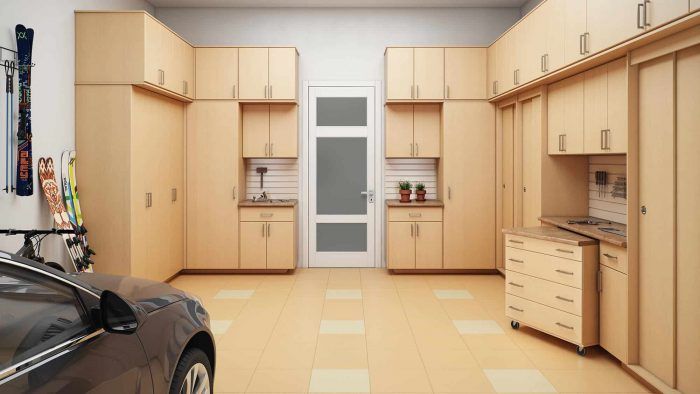
Sometimes a problem arises in a homeowners’ association when an owner installs in their parking space (which, as is normal, adjoins a neighbouring space) a large metal cabinet anchored to the floor.
Can the owner put whatever they like in their parking space?
Quite apart from the fact that this is not the proper use of that property (its purpose is to keep a vehicle, not to install fixed elements and store all kinds of objects indiscriminately, which would be the function of a storage room), the neighbour cannot alter their property as they please to the detriment or harm of another owner, since the neighbour’s manoeuvre into their own space, which they could previously make without any problem, will probably be hindered, bearing in mind, moreover, that the other side of their parking space is a partition wall, and installing that cabinet right up against the dividing line between the two spaces reduces the area of both spaces that is free of fixed obstacles. Unless the cabinet were small and did not obstruct the other properties at all, installing it unilaterally would go against harmony within the community.
In addition, the following points should be considered:
1) In a cabinet, which is basically used for storage and placed so that it occupies almost half of the space, the owner will want to keep a great many objects, given its size and capacity. It is clear that storing all kinds of objects indiscriminately in a place intended primarily for keeping vehicles with petrol tanks is clearly dangerous because it is highly flammable, and it therefore also constitutes an activity prohibited by the final paragraph of article 7 of the LPH, while at the same time breaching the good-neighbourly relations deriving from the obligations imposed on co-owners by article 9.2 and 9.6 of the LPH, and likewise exceeding the normal scope of property rights under article 348 of the Civil Code within the framework of the co-ownership regime governed by the LPH, in a clear and obvious abuse of rights prohibited by article 7 of the Civil Code
2) A large cabinet, even if it only reaches exactly half of the dividing line with the neighbour’s space, clearly harms the neighbour, since it adjoins their parking space, because the property and communal areas are not conceived as an absolute co-ownership but for their proper use and enjoyment. And it may obstruct the manoeuvres of the other co-owners.
What do the regulations say about this?
The Horizontal Property Act (Ley de Propiedad Horizontal, LPH) provides:
Article seven.
1.The owner of each flat or commercial premises may alter its architectural elements, installations or services provided that this does not impair or alter the safety of the building, its general structure, its external configuration or condition, or harm the rights of another owner, and must notify the person representing the homeowners’ association of such works beforehand.
Article nine.
1.The obligations of each owner are:
a) To respect the general installations of the community and other communal areas, whether for general use or for the private use of any of the owners, and whether or not they are included in their flat or premises, making proper use of them and preventing damage or deterioration at all times.
b) To keep their own flat or premises and private installations in a good state of repair, in such a way that they do not harm the community or the other owners, compensating for any damage caused through their own negligence or that of the persons for whom they are responsible.
Furthermore, the Spanish Building Act (Ley 38/1999, de 5 de noviembre, de Ordenación de la Edificación) states in article 3:
3. Basic building requirements:
“In order to guarantee people’s safety (…), buildings must be designed, constructed, maintained and preserved in such a way that the following basic requirements are met:
1. a) Relating to functionality:
a1) Use, so that the layout and dimensions of the spaces and the provision of installations make it easy to carry out the intended functions of the building properly.”
Unfortunately, this improper use of parking spaces (installing cabinets in them that can bother the neighbours) sometimes occurs when owners cannot use them to park their vehicles because of failure to meet the minimum dimensions or difficult access. So the first thing they should do is check whether they are still within the time limit to claim against those responsible and whether the spaces really fail to meet the local authority’s minimum dimensions.
Any questions?