Seville Court of First Instance no. 15 has upheld in full the lawsuit filed by a homeowners’ association (our client) against the developer that sold and handed over the building, as the owners had serious problems getting into their garage.
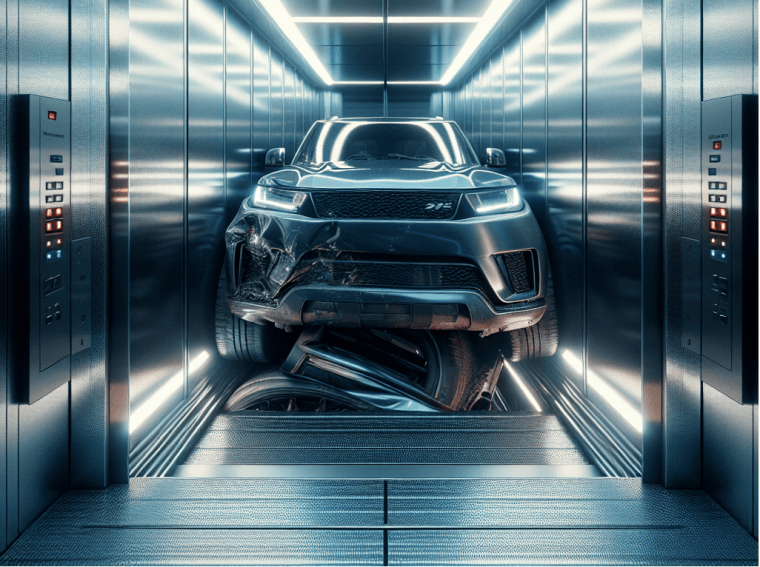
Specifically, the problem was twofold. On the one hand, the car lift installed had insufficient door and cabin width (2 metres for both), whereas most car lift manufacturers start from a greater width; in addition, the one-way access street was very narrow and the angle of approach very sharp.
All of this directly made it impossible for some owners to get their cars into the car lift, and the models that could fit had to make countless manoeuvres to get in, folding in the wing mirrors, being unable to get out of the vehicle inside the cabin, etc., making it unsustainable to carry out these long manoeuvres every day, each of which could take up to 10 minutes. All of this was proven by the videos of the manoeuvres included in DPcon’s expert report.
The judgment thus ruled:
According to the claimant’s expert report, with regard to the car lift:
a) the access door to the garage car lift measures 2.00 metres wide, compared with the 2.15 metres shown on the plan in the Building Logbook.
b) the actual width of the cabin is 2.00 metres, compared with the approximately 2.40 metres shown on the plan in the Building Logbook.
c) the width of the shaft in which the cabin is fitted is 2.70 metres.
d) Manufacturers such as Embarba, Wittur, Mp ascensores and Otis include in their catalogues:
i) cabin widths ranging from 2.30 metres to 2.80 metres.
ii) shaft widths ranging from 3.125 metres to 3.80 metres.
(…)Furthermore, the claimant’s expert report proves that the dimensions of the garage entrance and parking spaces are unsatisfactory for proper use of the garage. All this is consistent with the videos on record in the proceedings, which show that the manoeuvres to enter and leave the garage go beyond what is reasonable and tolerable.
On the other hand, in addition to the particularly narrow car lift, the owners’ parking spaces did not meet either the minimum dimensions of Seville’s PGOU (general urban development plan) or the basic functionality requirements of the Spanish Building Act (Ley de Ordenación de la Edificación, LOE).
Specifically, the expert report showed that most of the spaces were not suitable for normal-to-large vehicles. They had been sold in the title deeds without specifying the type of vehicle they were intended for, but given the (high) price paid and the fact that the PGOU did not allow these spaces to be particularly small, it was shown that the spaces could be used, at best, for light vehicles and, at worst, for two-wheeled vehicles. The developer was therefore ordered to compensate each owner for the difference between the market value of those spaces and whatever residual value they might have for them.
However much the defendant developer insisted that the spaces had the surface area (the square metres) stated in the title deeds, the square metres stated in the description of the spaces have nothing to do with how functional those spaces are, because if there are fixed elements such as columns or walls in those parking areas, the spaces will no longer be easy to access. What matters is that they meet the minimum width and length dimensions, and the tolerances allowed for fixed elements under the PGOU. Bear in mind, moreover, that no space is considered a parking space if, even though it meets the dimensional requirements, it does not allow vehicles easy access and manoeuvring.
And an adequate space is not one where only a light or small car can park, bearing in mind that nowadays owners who had only one parking space per household would normally have a medium-to-large vehicle (a saloon, an SUV or an estate car) and should be able to park it in the garage beneath their home, rather than having to go several blocks away, with all the daily carrying of people and bags that this entails.
So in the end the judge ruled in our favour, upholding the claim in full, and the claimant homeowners’ association was awarded in the judgment the sum of €201,485.50 as compensation for the problems with its garage, made up of €94,521.50 – the estimated budget for installing a new car lift – plus €106,964 – the compensation for the loss of value of the parking spaces.
The court also ordered the developer to pay interest from the date of the lawsuit and to pay the legal costs.
If you think the car lift or parking spaces in your building do not meet the minimum dimensions, contact us.
Any questions?